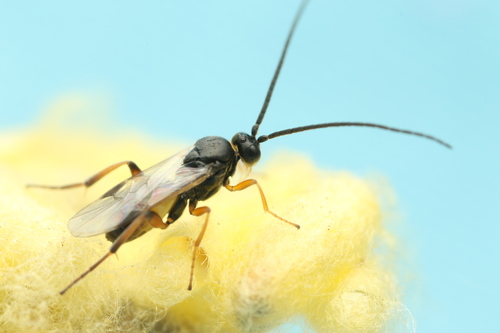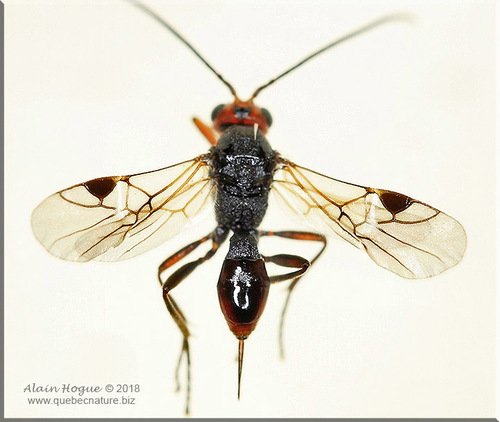
About Cotesia congregata (Say, 1836)
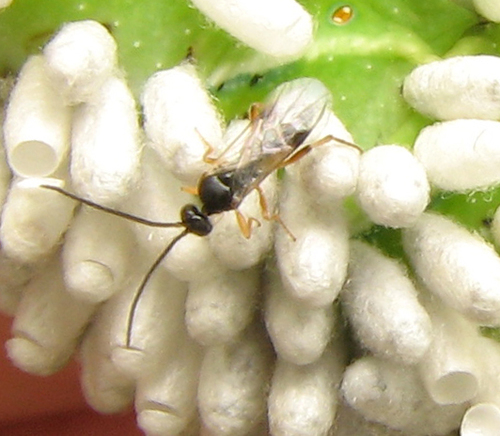
This section describes the genetics and life cycle of Cotesia congregata bracovirus, a symbiotic virus associated with the wasp Cotesia congregata. Cotesia congregata bracovirus has one of the largest known genomes among all viruses, at 567,670 base pairs. It is unusual among viruses because 70% of its DNA is noncoding introns. The genome is arranged into 30 DNA circles, ranging in size from 5,000 to 40,000 base pairs. Twenty-nine of these 30 circles code for at least one protein product. 66% of the genome consists of A-T residues. The most abundant gene products fall into four main groups. The first group is PTP proteins (protein tyrosine phosphatases), which dephosphorylate tyrosine amino acids on regulatory proteins. These PTPs interfere with certain cytoskeleton dynamics, a function that helps the parasite avoid host encapsulation. The PTPs from this virus are more closely related to cellular PTPs than to PTPs from other viruses. The second group is ank proteins, which contain ankyrin repeat motifs. These proteins are known to inhibit immune responses in vertebrates. The third group is cysteine-rich proteins, which are extremely similar to proteins excreted by wasp teratocytes. These proteins are suspected to inhibit the translation of storage proteins such as arylphorin, which leaves more free resources available for the parasite larvae. The fourth group is cystatin proteins, which inhibit cysteine proteases. This activity prevents the breakdown of the cysteine-rich group 3 proteins. Cystatins have not previously been identified as a viral gene product. Based on similarity to related proteins found in parasitic nematodes, these cystatins also likely have an immunosuppressive function. All other protein products from this genome have no known homologs, and their functions remain unknown. Much of the discovered sequence makes placing this virus in a phylogenetic position difficult, and supports the theory that the virus was assembled rather than evolving gradually. Its closest known relatives are nudiviruses and their baculovirus relatives, though this shared ancestry dates back approximately 75 million years. In the life cycle of Cotesia congregata, adult female wasps lay their eggs into second or third instar larvae of the tobacco hornworm (Manduca sexta) and tomato hornworm (Manduca quinquemaculata). An instar is the life stage between one molt and the next; for example, the second instar occurs after the first molt and before the second molt. At the same time as laying eggs, the wasp injects its symbiotic bracovirus and venom into the host's hemocoel. The virus suppresses the hornworm's internal defensive immune responses. The wasp eggs hatch inside the host hemocoel within two to three days. As they hatch, the eggs release special cells from their serosa called teratocytes. These cells grow into giant cells that are visible to the naked eye. Teratocytes secrete hormones that work together with the virus and wasp venom to arrest the host's development. After hatching inside the caterpillar host, wasp larvae go through 2 molts inside the host's hemocoel. Between 12 and 16 days after oviposition, third instar wasp larvae emerge from the caterpillar and spin cocoons. Adult wasps emerge from these cocoons 4 to 8 days later. Not all parasite larvae successfully emerge from the host. Dissection of caterpillars after successful larval emergence revealed three categories of remaining wasp larvae: dead or dying wasp larvae at various development stages that had been partially or completely encapsulated by the host's immune system; the parasite has strong immunosuppressive capabilities, but the host's immune system can partially recover over several days, so these larvae may have been encapsulated at a very late stage. The second category is alive wasp larvae that showed reduced growth compared to successfully emerging larvae, and may not have been able to reach the second instar stage. The third category is second instar wasp larvae that are developmentally similar to the larvae that emerged successfully. Cotesia congregata has the shortest flagellated spermatozoa recorded in animals, with a total length (nucleus plus flagellum) of 6.6 μm. This is 8800 times shorter than the longest animal flagellated sperm, produced by Drosophila bifurca. Pupae of Cotesia congregata may themselves be hyperparasitized by wasps of the genus Hypopteromalus.