About Cota tinctoria (L.) J.Gay
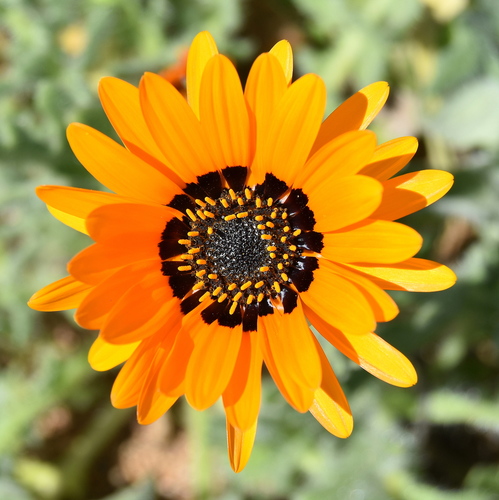
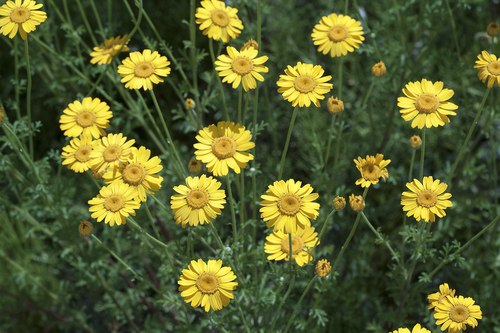
Cota tinctoria (L.) J.Gay has common names including golden marguerite, yellow chamomile, oxeye chamomile, dyer's chamomile, Boston daisy, and Paris daisy. It is a species of perennial flowering plant in the sunflower family, and it is still widely called by its scientific synonym Anthemis tinctoria in horticulture. This short-lived plant is often treated as a biennial. It is native to Europe, the Mediterranean, and Western Asia, and has become naturalized in scattered locations across North America. It produces aromatic, bright green, feathery foliage. Its serrate leaves are bi-pinnatifid, meaning finely divided, and have a downy texture on their undersides. It grows to a height of 60 cm (24 in). It bears abundant yellow daisy-like terminal flower heads on long, thin, angular stems, and blooms throughout the summer. It has no culinary or commercial uses, and only limited medicinal uses. However, it yields excellent yellow, buff, and golden-orange dyes that were historically used to color fabrics. Cota tinctoria is grown in gardens for its bright attractive flowers and fine lacy foliage, and a white-flowering form of the plant exists. Under its synonym Anthemis tinctoria, the cultivar 'E.C. Buxton' has received the Royal Horticultural Society's Award of Garden Merit. The popular seed-raised cultivar 'Kelwayi' grows to 65 cm tall, and bears yellow flowers 5 cm wide. This species hybridizes with Tripleurospermum inodorum to produce the hybrid × Tripleurocota sulfurea.