About Costus spectabilis (Fenzl) K.Schum.
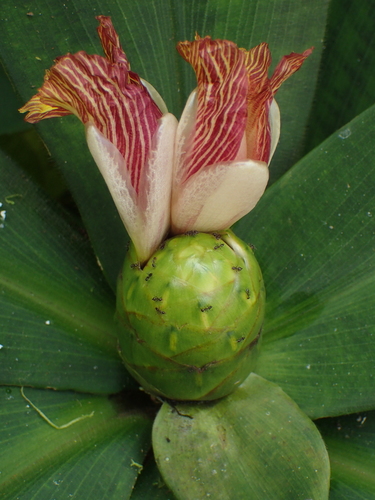
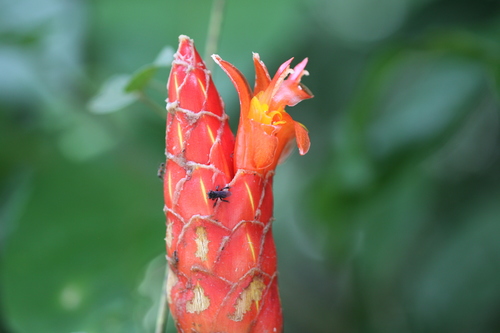
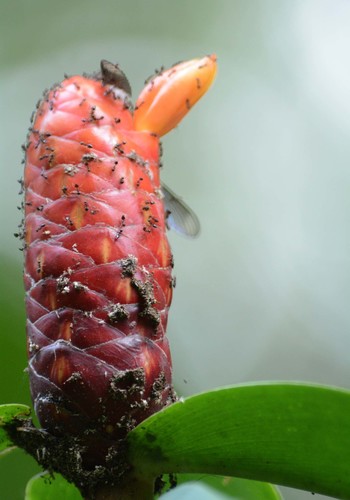
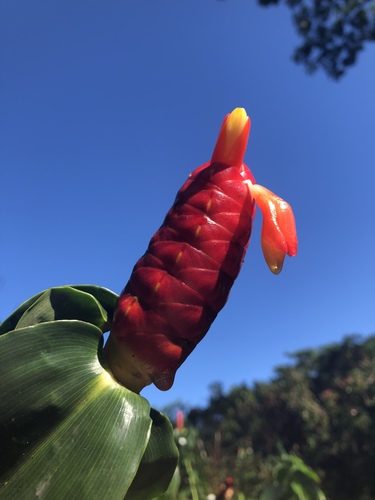
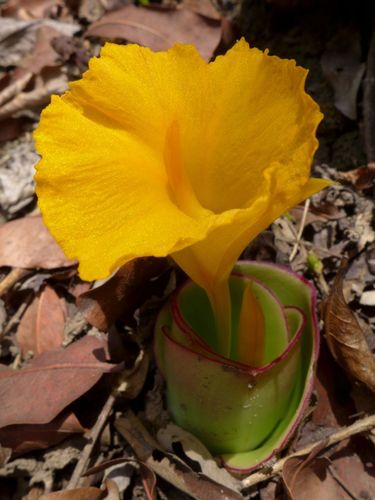
Costus spectabilis (Fenzl) K.Schum. is a geophytic plant species that produces four large, 12 by 12 cm fleshy leaves that lie flat on the ground, forming a basal rosette. The leaves are hairless on their upper surface, and covered in fine hairs on their lower surface, particularly along the midrib. Leaf margins are smooth and entire, and often edged with purple-pink color. The inflorescence is terminal, growing from the center of the leaf rosette. The flowers are showy, bright yellow, and open one at a time. Individual flowers die rapidly after opening, and are immediately replaced by a new flower. This species goes dormant during the winter, dying back to a centipede-like rhizome that has no roots. In spring, it produces new paddle-shaped leaves that press flat against the soil once fully developed, with a shape similar to water-lily pads. The lower abaxial surface of the leaves has a spongy white texture. Fully open flowers are around 9 cm across, bright yellow with a crisped margin, and feature a large staminodial labellum. The flowers have a shape similar to pumpkin flowers, and have a soft, thin texture. This geophyte occurs across much of tropical Africa, with recorded occurrences in Angola, Benin, Burkina Faso, Burundi, Cameroon, Chad, Côte d'Ivoire, Democratic Republic of the Congo, Ethiopia, Gabon, Ghana, Guinea, Kenya, Malawi, Mali, Nigeria, Senegal, Sierra Leone, Sudan, Tanzania, Togo, Uganda, Zambia and Zimbabwe. It grows in wooded grassland and deciduous woodland, and can occasionally be found near termite mounds or around rocky areas.