About Costasiella ocellifera (Simroth, 1895)
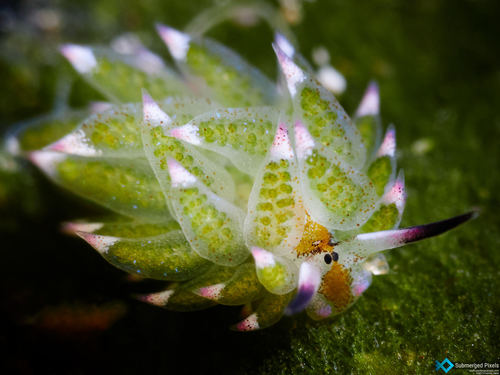
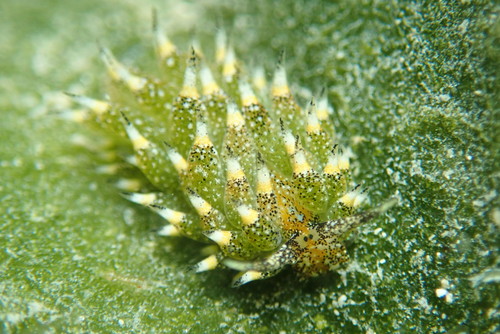
Costasiella ocellifera is a shell-less sacoglossan sea slug. Its body is white and somewhat translucent, speckled with small black dots. Most of the body's upper surface is covered in pointed cerata, which are translucent like the body but contain digestive gland ducts that appear green, from chloroplasts the sea slug has digested. The cerata are arranged in five to six diagonal rows, with four cerata per row. Each ceras has a white tip, with a light orange-yellow ring just below the tip, and is speckled with small black, white, and blue iridescent spots. The top of the head is orange-yellow, and the species has two large horn-like semi-translucent rhinophores. The tips of the rhinophores appear black due to dense clusters of black dots. Two distinct black eyes sit between the rhinophores; the area around the eyes is almost always entirely white, and is sometimes described as resembling an eye mask. Directly behind the eyes and rhinophores is a blue eyespot, the distinguishing characteristic of this species. It has a tail that resembles a ceras. Like all sacoglossan slugs, this species has a radula with only one row of teeth, which allows it to skillfully puncture the cell wall of its food algae, Avrainvillea. Adult individuals average about 5 mm in length, and can grow up to 13 mm. Shell-less sacoglossan sea slugs like this species are often preyed on by small predatory fish, some nemertean species, cnidarians, crustaceans, and even some carnivorous coral species. To protect itself from predators, C. ocellifera has developed a chemical defense system that uses secondary metabolites from the Avrainvillea algae it feeds on. Using thin-layer chromatography (TLC), scientists have identified this metabolite as avrainvilleol. This chemical defense is so effective that in a laboratory test with predatory bluehead wrasse fish, any sea slug that was eaten was almost immediately spit back out unharmed. In addition to chemical defense, this sea slug also has an effective camouflage defense. Digested algae chloroplasts turn its cerata green, helping it blend in with the surrounding Avrainvillea algae. C. ocellifera shows long-term retention of functional kleptoplasty, meaning it can ingest functioning chloroplasts from algae and survive using photosynthesis for up to 65 days when starved. This species has only been found in the tropical and subtropical Atlantic Ocean region, within which it has been recorded in the Bahamas, Barbados, Belize, Bermuda, the Dominican Republic, Florida, Honduras, Jamaica, and some areas of Mexico. It inhabits shallow coastal waters, and is almost always found on the algal species Avrainvillea nigricans. The distribution of this sea slug is linked directly to the distribution of Avrainvillea algae. Like all other sacoglossan species, C. ocellifera is a simultaneous hermaphrodite, meaning it has both male and female reproductive organs and produces both types of gametes. It reproduces via internal fertilization, then spawns its eggs in a distinct spiral pattern onto the Avrainvillea nigricans algae it eats. This species is unique in having poecilogony larvae, meaning its larvae can display two different types of development. Multiple studies have confirmed C. ocellifera can produce both lecithotrophic (aplanktonic) and planktotrophic larvae. Lecithotrophic larvae get nutrition from reserves stored in the egg, such as the yolk sac. Planktotrophic larvae feed on plankton in the water column. Planktotrophic larvae are free-swimming for approximately one month after hatching, while lecithotrophic larvae complete their metamorphosis while still inside their eggs. Eggs with smaller diameters typically produce planktotrophic larvae.