About Costasiella kuroshimae Ichikawa, 1993
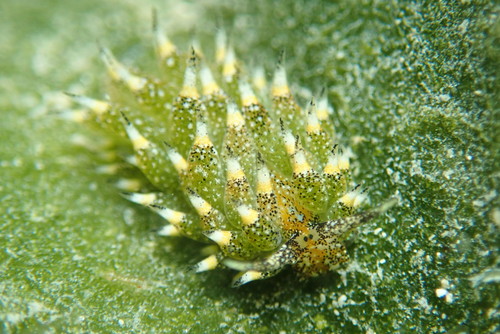
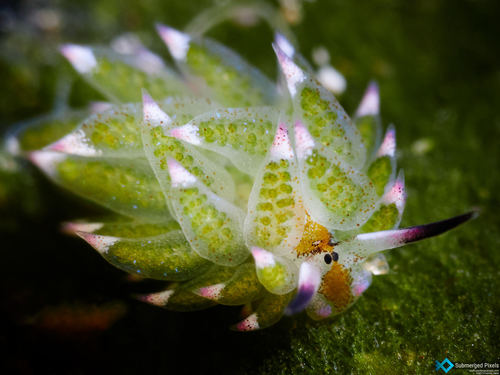
Costasiella kuroshimae, first discovered in 1993 off the coast of the Japanese island Kuroshima, has been found in waters near Japan, the Philippines, and Indonesia, and it lives in tropical climates. Its type locality is Kuroshima, Taketomi, Okinawa, Ryukyu Islands. This species has two dark eyes and two rhinophores that emerge from the top of its head; these rhinophores look similar to sheep's ears or insect antennae. Adults range in length from 5 to 10 mm, which is 1⁄4 to 3⁄8 of an inch. Its leaf-like appearance comes from cerata arranged in rows across its body. These cerata hold digestive glands that help the sea slug obtain and store food, and they also assist with defense and respiration. Costasiella kuroshimae can carry out a physiological process called kleptoplasty, in which it retains chloroplasts from the algae it eats. Absorbing these chloroplasts allows the species to indirectly perform photosynthesis. It is a selective feeder that only eats algae from the genus Avrainvillea, and it sequesters chloroplasts from this algae into its own cells to use for short-term photosynthesis. Even when photosynthesis is not active, chloroplasts act as a nutrient storage larder, letting the slug survive without food for an extended period. This adaptation makes C. kuroshimae unusual among non-photosynthetic marine animals.