About Cosmopolites sordidus (E.F.Germar, 1823)
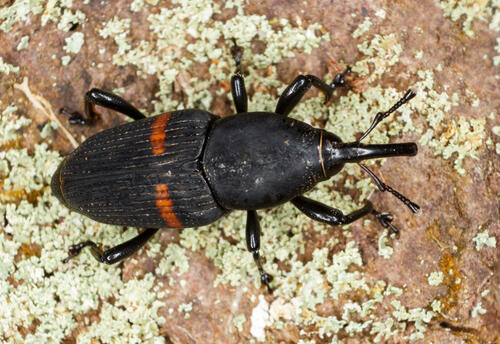
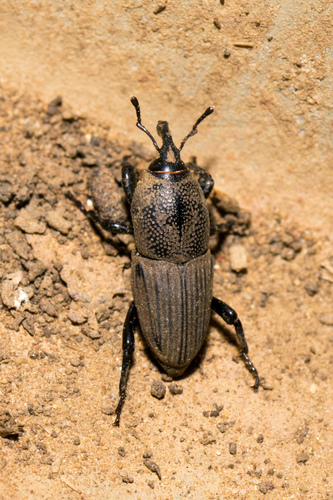
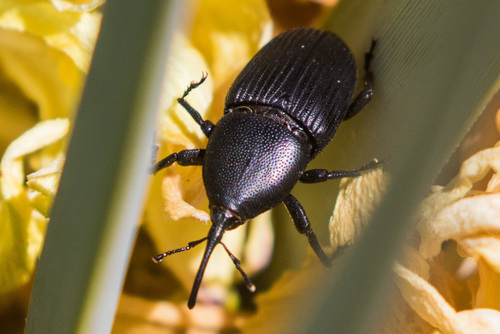
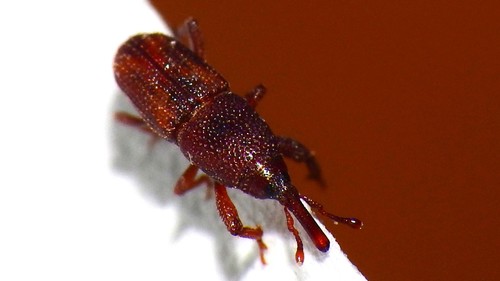
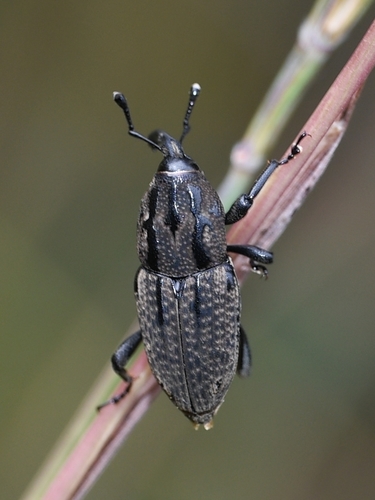
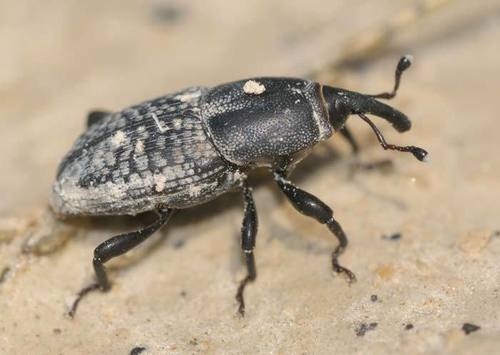
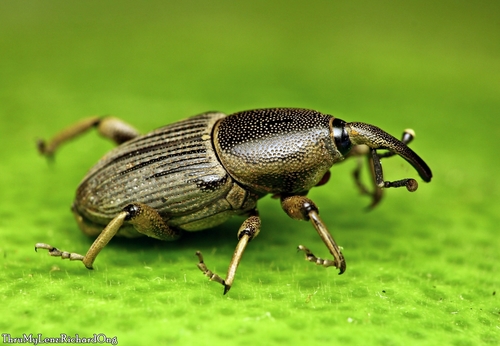
This species, the banana root borer, has the scientific name Cosmopolites sordidus (E.F.Germar, 1823). Adult banana root borers reach around 11 mm (3⁄8 inch) in length, and have a glossy greyish-black or dark brown body. Unlike billbugs of the genus Sphenophorus, their thorax has no depressions. Each leg’s tibia has an extra hook-like claw that the insect uses to cling to plants. Larvae are plump and whitish, with a reddish-brown head. A large spiracle sits on the larva’s eighth abdominal segment, while all other abdominal segments have small spiracles. The last two abdominal segments are truncated, and fused together to form a plate-like structure. Pupae have an irregular shape, and the developing wings and legs can be seen through the pupal case. The banana root borer most likely originated in southeastern Asia and Indonesia. It now has a cosmopolitan distribution, and occurs in all banana-growing regions across the world: southern Asia, Africa, Macaronesia, Australia, South America, Central America, the West Indies, and Mexico. In the United States, it is only found in Monroe and Miami-Dade Counties, Florida. The species is easily transported between locations during its larval stage, inside sections of root or corm. Banana root borers feed on any Musa (banana) species, but prefer plantains and East African Highland bananas (matoke) over dessert and brewing bananas. They are attracted to their host plants by volatile chemicals released by the plants, especially from damaged corms. They have been recorded feeding on Manila hemp, sugarcane, and yams, but this likely only happens when they cannot access banana plants. Adult females lay eggs one at a time, either between the leaf sheath and stem, or at the base of the stem near the corm. Eggs hatch after roughly six days, and larvae then burrow into the stem or root. Their burrowing activity weakens the plant, making it more likely to blow over. The full life cycle lasts 30 to 40 days, with a 15 to 20 day long larval stage. In southeastern Asia, the banana root borer is preyed on by the beetle Plaesius javanus, which feeds on the root borer’s eggs, all larval stages, pupae, and adults. This predatory beetle has been introduced to other parts of the banana root borer’s range to test biological pest control.