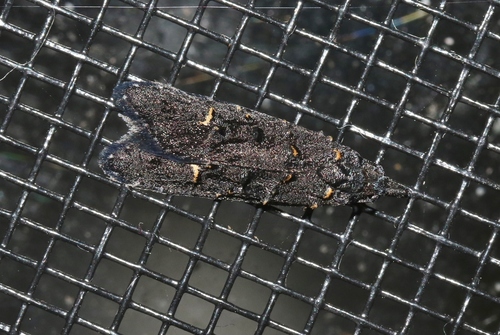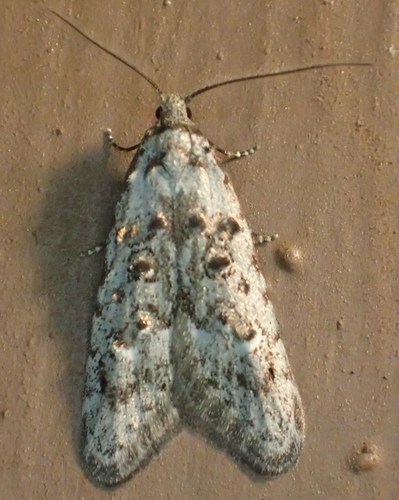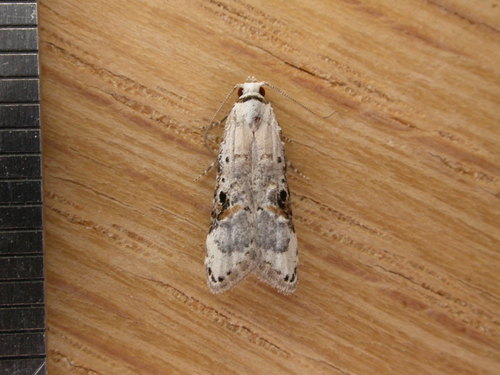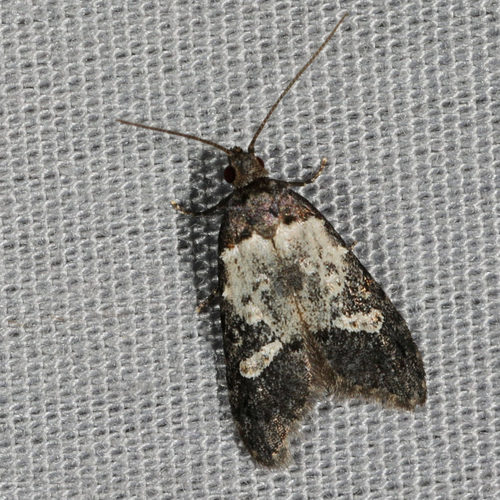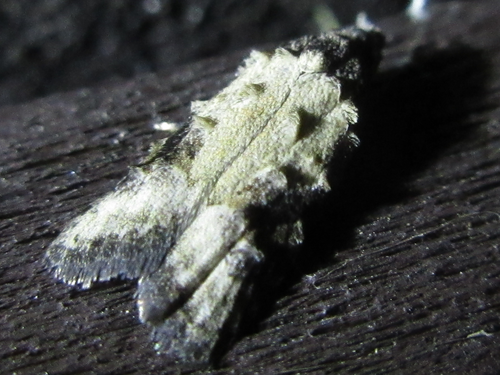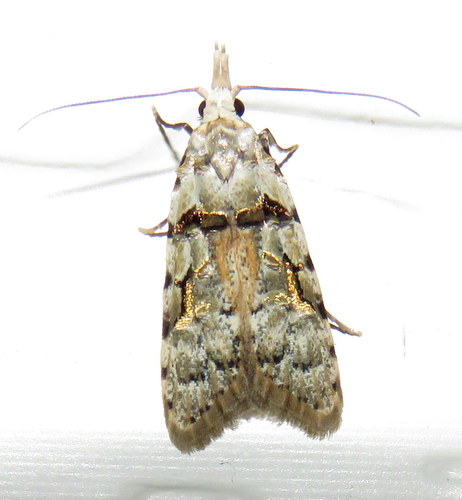
About Coscinoptycha improbana Meyrick, 1881
This species, Coscinoptycha improbana, was originally described by Meyrick as follows: Both male and female individuals have a wingspan ranging from 6+3⁄4 inches to 7+1⁄2 inches. The head is silvery-white. The palpi are white, with the basal two-thirds of the second joint distinctly dark fuscous on the underside. Male antennae are fuscous, with the basal joint white; female antennae are whitish. The thorax is white, with some fuscous mixing. The abdomen is whitish. The legs are whitish, with the anterior and middle tibiae and tarsi marked with broad dark fuscous bands.
The forewings are very narrow. The costa is slightly bent close to the base and a little before the apex, and almost sinuate in the middle. The hindmargin is nearly straight and very oblique. The base color of the forewings is white. In males, there is an irregular ochreous-grey suffusion toward the margins. Around seven irregularly placed black linear spots sit along the costa. Males have a raised longitudinal bladder-like membranous ridge that extends from near the base to two-fifths of the way along the disc; the costal half of this ridge is covered in white scales, while the dorsal half is naked, pellucid, and shining. This ridge is absent in females, but females have a small irregular blackish spot on the disc at two-fifths of the wing length. There is a grey cloudy spot on the inner margin at two-fifths that extends half-way across the wing; in males, this spot contains a transverse blackish mark, while in females it is obscurely mixed with blackish. There is a rather broad grey transverse central suffusion; in males this contains a short longitudinal black linear mark near the middle, and in females it holds a small roundish black spot plus some scattered black scales. A row of indistinct linear blackish spots runs along the hindmargin. The cilia are whitish, suffused with grey, and obscurely barred with a darker shade. The hindwings are thinly scaled and whitish, with the apex tinged greyish. The hindwing cilia are whitish, with a faint greyish tinge around the apex.
In terms of distribution, Coscinoptycha improbana is native to Australia. Within Australia, it is found from Eungella in Queensland, extending south through New South Wales, Victoria, and Tasmania. It also occurs on Norfolk Island. It has been present in New Caledonia since 2012, and in New Zealand since 1999. In New Zealand, it has been observed in the Northland, Auckland, and Waikato regions.