About Coscinasterias muricata Verrill, 1867
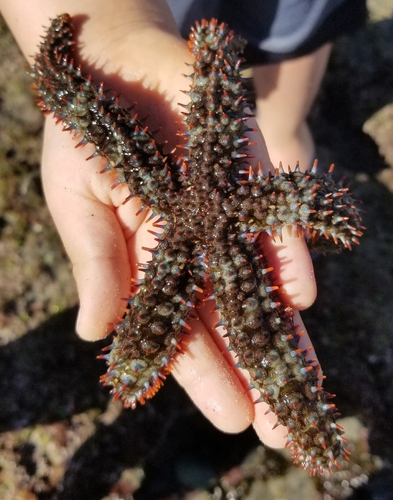
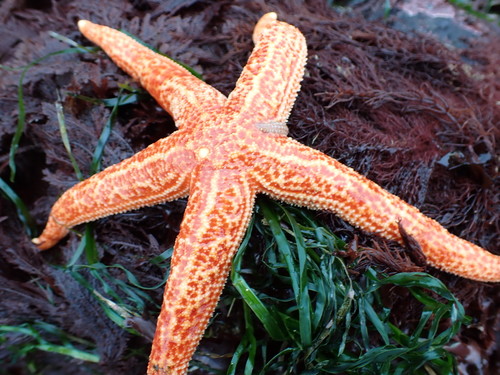
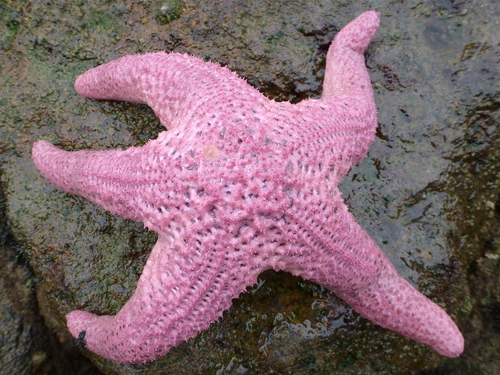
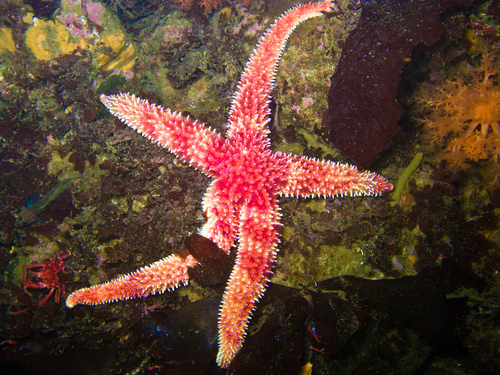
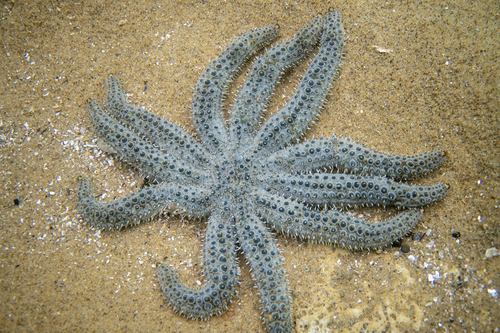
Coscinasterias muricata Verrill, 1867 is the largest starfish found in southern Australia, and can grow up to 50 cm (20 in) in diameter. It has between seven and fourteen arms, with eleven being the most common number. The aboral (upper) surface of its arms has longitudinal rows of short spines along the surface and margins, while the oral (lower) surface has two rows of tube feet. Its body is orange, mottled with shades of blue, green, grey, and reddish-brown. This starfish often sheds its arms, leaving it asymmetric until new arms finish growing. This species is native to temperate areas of the western Indo-Pacific region. In Australia, its range extends from Houtman Abrolhos in Western Australia through southern Australia and Tasmania, and reaches north to Port Denison in Queensland on the eastern Australian coast. It is also found in New Zealand, Lord Howe Island, and Norfolk Island. It is common in coastal areas around southern Australia and New Zealand, where it lives on rocks, under boulders, and in sandy habitats down to depths of about 150 m (500 ft). In sheltered small bays of Australia, the tunicate Pyura stolonifera can become the dominant species on the shallow seabed, preventing other sessile organisms from establishing there. The resulting habitat is suitable for filter feeders including sea cucumbers, brittle stars, and bivalve molluscs. Coscinasterias muricata, a carnivorous starfish that specializes in feeding on bivalves, can be found among these filter feeders. It is often located on mussel beds, and it also eats crabs and scavenges carrion. This starfish can reproduce asexually through binary fission. In this process, a groove forms on the surface of its central disc, and the two halves of the starfish pull apart. Each half then regenerates its missing tissues to form a complete new individual. Smaller individuals often reproduce through this asexual method. Larger individuals have an extended breeding season, and release sperm and eggs into the water during spring and summer for sexual reproduction. The resulting larvae are planktonic. Once the larvae are sufficiently developed, they settle onto the seabed in coralline algae habitats.