About Corythucha ciliata (Say, 1832)
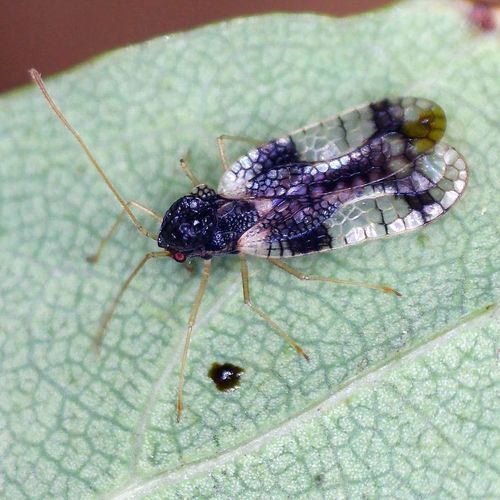
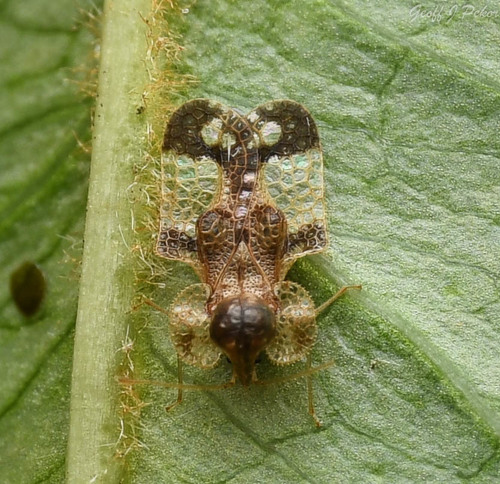
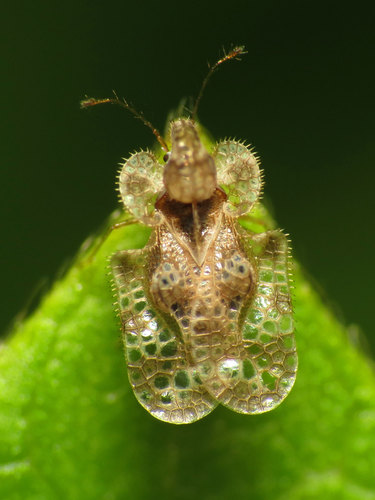
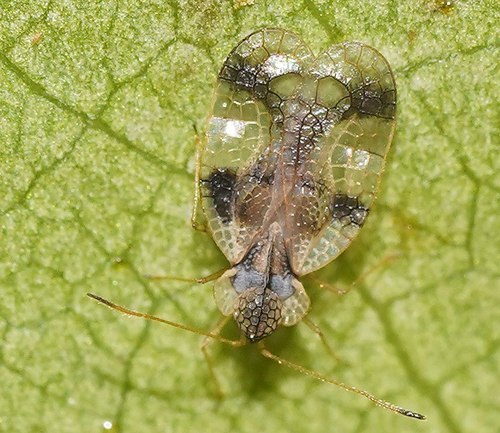
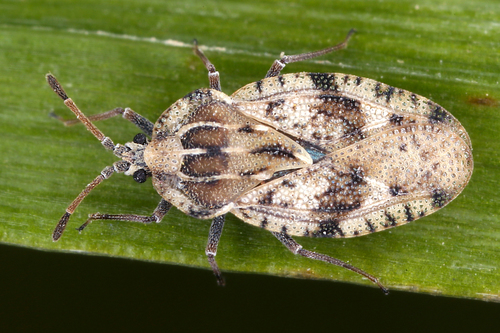
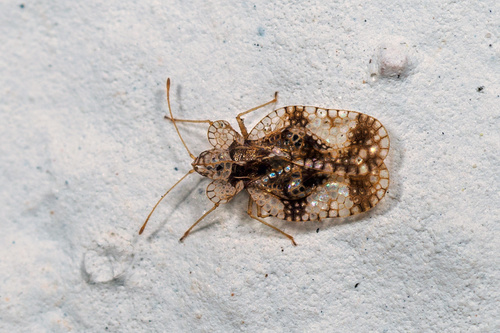
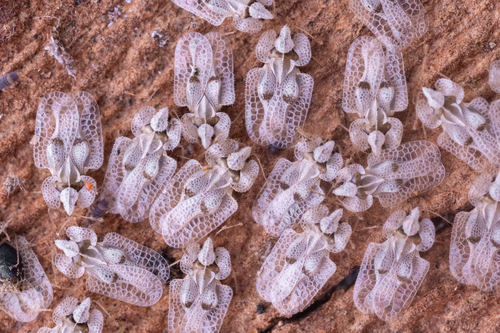
Adult sycamore lace bugs (Corythucha ciliata) are milky white, measuring between 3.2 and 3.7 mm (0.13 and 0.15 in) in length. They share a similar appearance with the cotton lace bug (Corythucha gossypii) and the Florida oak lace bug (Corythucha floridana), but can be told apart: they lack the brown crescent-shaped band on the body-wall carina that cotton lace bugs have, and they are larger than Florida oak lace bugs. The only brown marking on adults is a small spot on the protuberance of each elytron (wing-case). Nymphs are oval-shaped, dorso-ventrally flattened, black, and covered in prickly projections. This species can be most easily distinguished from other lace bugs by its association with sycamore trees. Corythucha ciliata is native to North America, where it occurs wherever its host trees grow. Its main host is American sycamore (Platanus occidentalis), but it is sometimes found on other Platanus species, and has also been recorded on Broussonetia papyrifera, Carya ovata, Chamaedaphne sp., Fraxinus sp., Quercus laurifolia, and Liquidambar styraciflua. In Europe, sycamore lace bugs were first observed in 1964 in Padova, Italy, and have since spread across Southern and Central Europe, with populations reaching as far east as Uzbekistan, where they infest London plane (Platanus × hispanica). While Corythucha ciliata does not kill trees on its own, it is often found in Central Europe alongside two tree-killing plant pathogenic fungi: Apiognomonia veneta and Ceratocystis fimbriata. This association has led to the hypothesis that the lace bug may act as a vector for these fungi. Feeding by the lace bug causes chlorotic stippling — light-colored patches from lost chlorophyll — to appear on leaves near veins. This stippling can spread across the entire leaf, turning the leaf pale or bronze, and ultimately causing leaves to drop prematurely. These feeding effects are most noticeable in late summer. After mating, adult females lay their eggs on the undersides of host tree leaves, usually near vein forks. Once eggs hatch, young nymphs stay clustered together initially, only moving to a new leaf when they reach the fourth instar stage. Nymphs puncture the leaf epidermis with their mouthparts to suck sap. There are five instar stages, after which nymphs undergo incomplete metamorphosis to reach adulthood. In Oklahoma during summer, the full life cycle takes approximately 44 days. In warmer parts of the species' range, where ideal temperatures range between 19 °C (66 °F) and 33 °C (91 °F), there can be 1 to 3 generations per year. Sycamore lace bugs stay on the undersides of leaves, where small black mounds of dried frass are visible, and shed nymphal skins often stick to the leaf surface. The upper leaf surface becomes speckled with white starting near the veins, then progressively turns paler or bronzed, and may drop early. This species generally overwinters as adults in crevices or under bark flakes, and can tolerate temperatures as low as −24 °C (−11 °F).