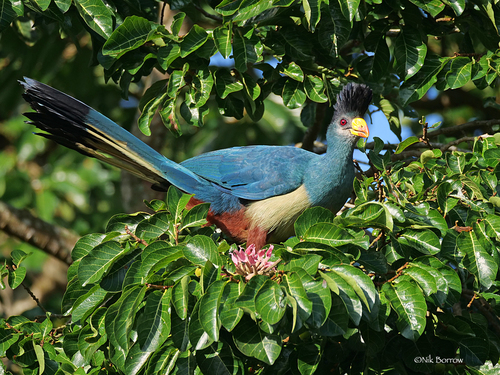
About Corythaixoides concolor (A.Smith, 1833)
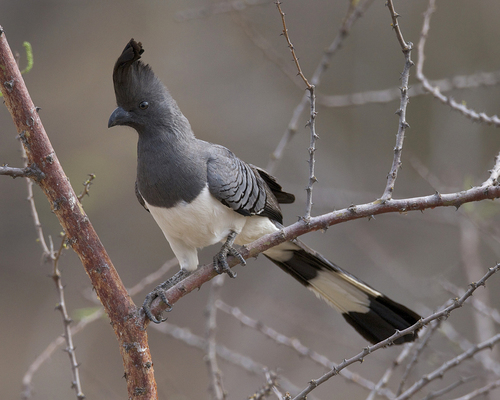
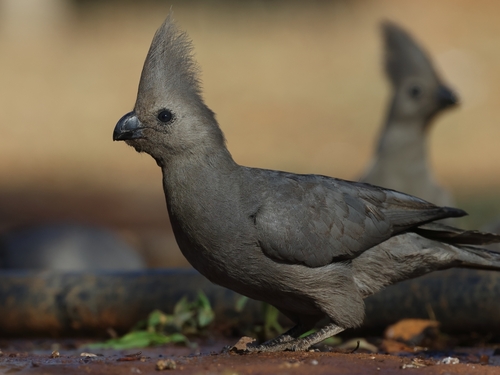
Males and females of Corythaixoides concolor are similar in appearance. The species measures 47–51 cm from bill tip to tail tip, and weighs 200 to 300 g. Their plumage is almost uniformly smoky-grey, they have long tails, and a wispy, back-swept crest 6 to 7 cm long that resembles the crest of mousebirds. When the bird is excited, the crest can be raised almost vertically. The strong, decurved beak is black, while the gape and tongue are noticeably pink. Plumage is darkest grey on the chin and throat, and palest around the eyes and on the belly. The breast plumage has a slight olive wash, similar to that of its close relative, the bare-faced go-away-bird. This species is native to southern Angola, southern Democratic Republic of the Congo, Zambia, southern Tanzania, Malawi, Mozambique, Namibia, Botswana, Zimbabwe, South Africa, and Eswatini. It inhabits arid to moist, relatively open savanna woodlands, especially areas with Acacia trees. It regularly occurs at the edges of miombo woodland, and is common along water courses, in dry riparian forest, and in Acacia woodland growing on alluvium. It is also commonly found on farms, and in suburban gardens and parks. The species requires access to water, and disperses along tributaries of desert rivers when water flows. It is not found in areas without suitable fruiting trees, and appears to abandon areas where woody plant encroachment takes place. It does not have regular migrations, but wanders irregularly to search for food and water. While its flight is rather slow and labored, it can travel long distances. When in open tree tops, it displays the agility characteristic of the Musophagidae family, running along tree limbs and jumping between branches. It can form groups of up to 20 to 30 individuals that travel together to search for fruit and insects near tree tops. Its diet consists mainly of fruit (such as wild figs and berries), flowers, buds, leaves, termites, and snails. It takes fruit from plants in the genera Ficus, Viscum, Loranthus, Diospyros, Lannea, Ziziphus, Salvadora, Flueggea, and others. It also feeds on fruit from invasive exotic species like seringa, and disperses their seeds.