About Coryphopteris simulata (Davenp.) S.E.Fawc.
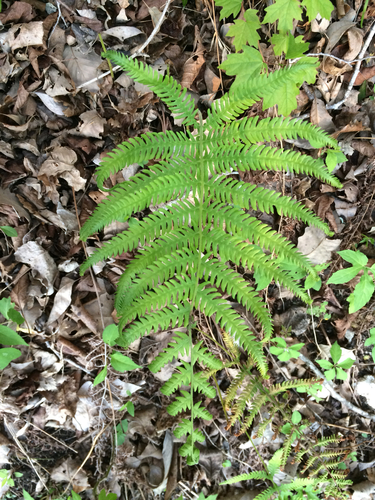
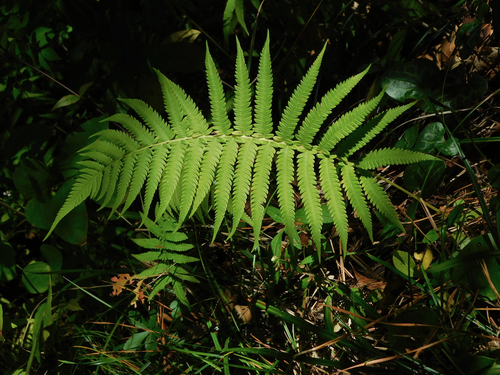
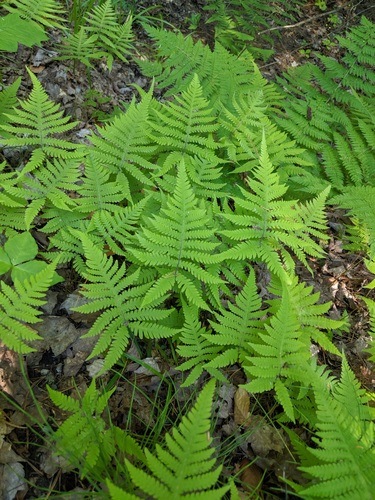
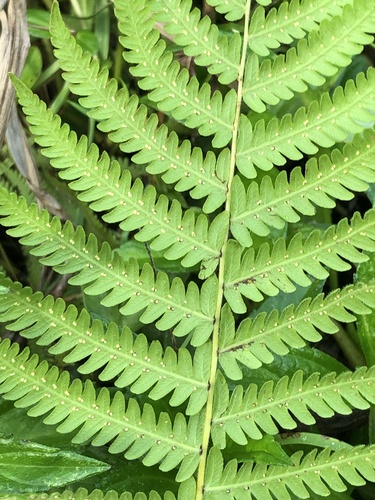
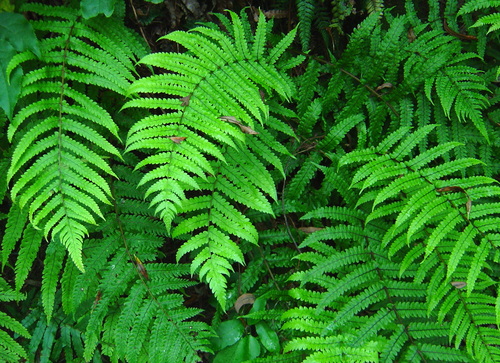
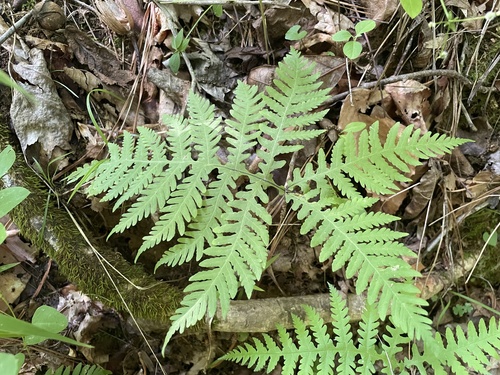
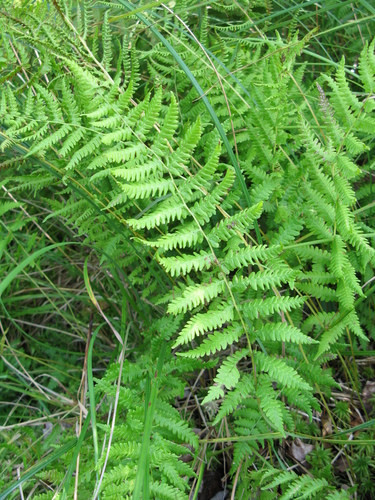
Coryphopteris simulata (Davenp.) S.E.Fawc. is bright green. Its fronds vary slightly in shape, and typically reach around 61 cm (24 in) in length. The frond stalk is long, slender, and measures 20.3 cm (8 in); all stalks are thin, with slight scales or hairs. The upper portion of the stalk is yellow-green, while the base is light brown. This species has monomorphic, pinnately compound leaves that range from 10 to 40 cm (3.9–15.7 in) long and 7.6 to 15.3 cm (3–6 in) wide. The branching pattern looks opposite at first glance, but close inspection reveals it is actually slightly alternate. Most leaf veins are unbranched, though some branching occurs toward the lower part of the leaf blade. Coryphopteris simulata produces both fertile and sterile leaflets. Leaflets are twice-compounded, divided along the mid-vein into 15 to 18 lobes, and oblong in shape. They narrow toward the axis, with more noticeable narrowing near the base. Most leaflets grow erect, but the lowest pair points downward. Leaflets range from 25 to 80 cm (9.8–31.5 in) long. Fertile and sterile leaflets are similar in shape and size, though fertile leaflets are usually slightly longer than sterile ones. Round sori grow on the underside of leaflets. The indusium is pale tan and kidney-shaped. The rhizome is slender, black, bears some scales, spreads widely and branches extensively. Older roots are short, black, thin and wiry, while there are many young, hairlike rootlets. This terrestrial fern is native to Eastern Canada (New Brunswick, Nova Scotia, Ontario and Québec), the North-Central United States (Wisconsin), the Northeastern United States (Connecticut, Maine, Massachusetts, New Hampshire, New Jersey, New York, Pennsylvania, Rhode Island, Vermont and West Virginia) and the Southeastern United States (Alabama, Delaware, the District of Columbia, Maryland, North Carolina, Tennessee and Virginia). An isolated population found in southwestern Wisconsin grows far outside the species' expected range, and the species is generally uncommon. It grows in shaded, marshy wetlands and bog areas including cedar, spruce, larch, and sphagnum swamps. It grows among bryophytes, particularly Sphagnum, and prefers moist, acidic, soft, spongy soil, where it is most often found.