About Coryphellina marcusorum (Gosliner & Kuzirian, 1990)
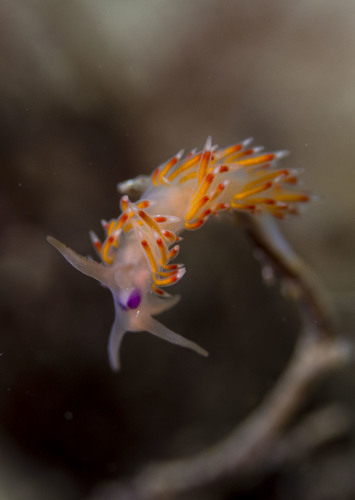
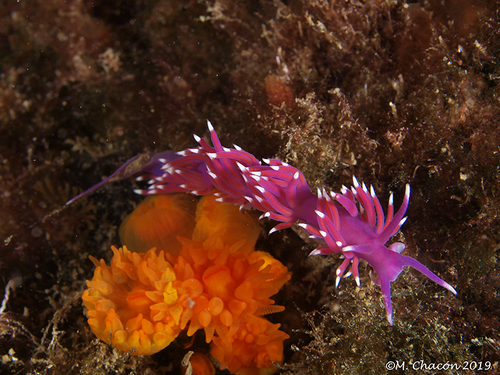
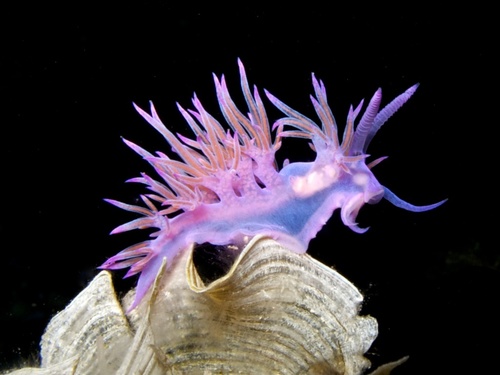
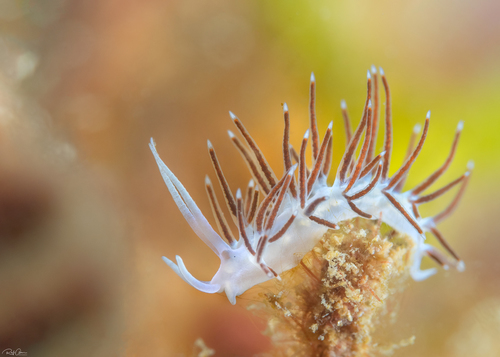
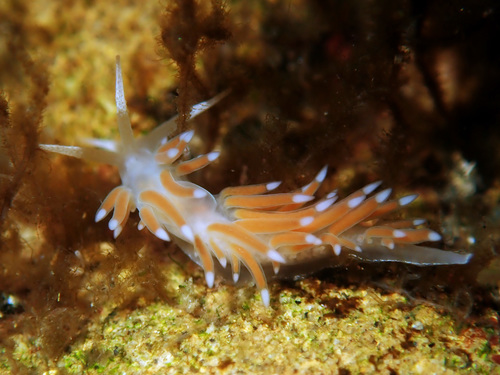
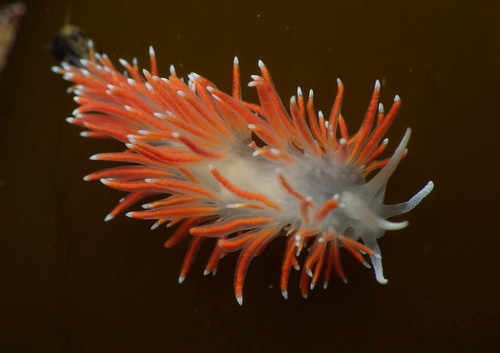
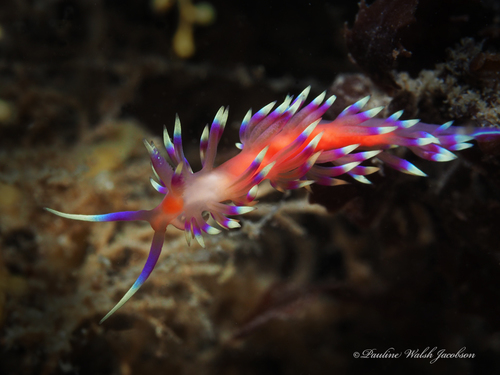
Coryphellina marcusorum typically has a mostly translucent pink or orange body. Its elongated rhinophores, foot corners, and cerata have opaque white (or sometimes opaque yellow) tips, with a broad purple band located just below these opaque tips. The posterior surface of the rhinophores can hold up to one hundred papillae. The oral tentacles are elongated and thin, and they are longer than the rhinophores. The maximum recorded body length of this species is 25 mm, with some individuals reaching up to 30 mm. Coryphellina marcusorum is very similar in coloration to Coryphellina arveloi, a recently described species from Africa. A comparison between this species and other Flabellinidae species from Mexico is provided in the species description of Orienthella fogata. This species was first described from specimens collected at Isla San Diego, Baja California, Mexico. It is thought to have two separate disjunct populations in waters around Central and South America: one population along the west coast of Central America in the eastern Pacific Ocean, ranging as far east as the Galapagos Islands, and the other on the eastern side of the continent in the Caribbean Sea and western Atlantic Ocean, ranging south to Brazil. The minimum recorded depth at which this species has been found is 3 m, and the maximum recorded depth is 22 m.