About Coryphella verrucosa (M.Sars, 1829)
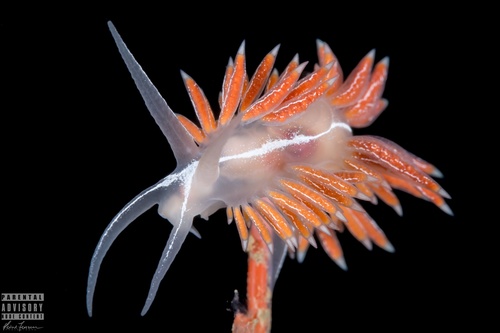
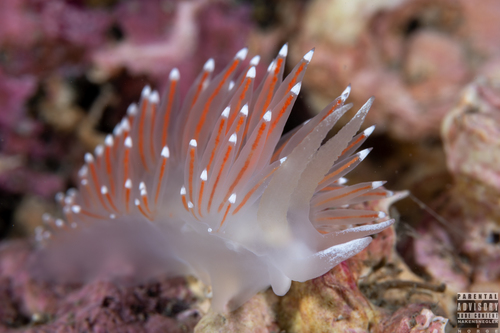
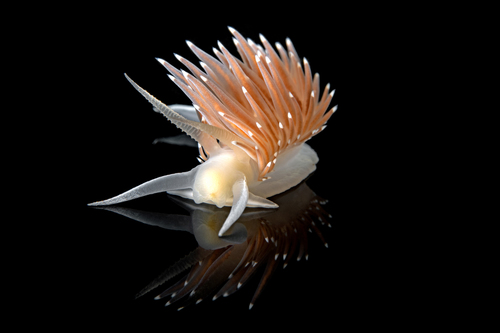
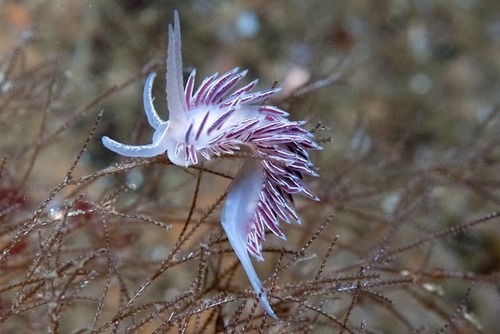
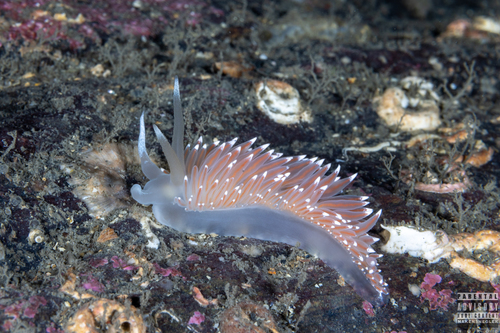
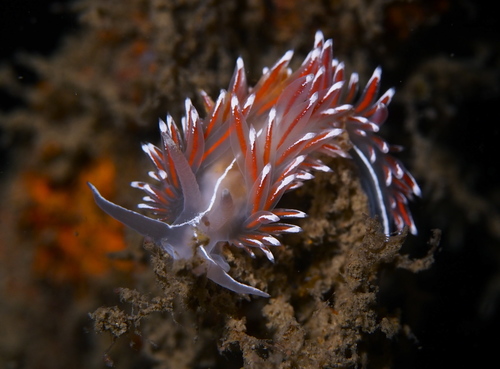
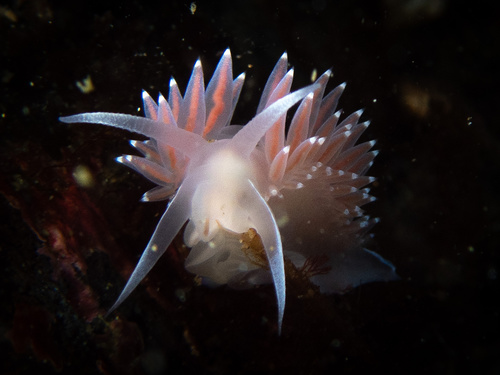
Coryphella verrucosa was first described based on an individual with unusually short, rounded cerata, which gave this species its specific epithet verrucosa. The name has been widely applied to specimens that look very different and have long cerata, including Coryphella rufibranchialis, the type species of the genus Coryphella. This nudibranch has a translucent white body. Its tail is elongated and pointed, with a mid-dorsal stripe of opaque white pigment that contains round translucent spots. This white line may extend forward from the tail along the back between the cerata, breaking into spots as it goes. Across this species’ range, there are differently coloured forms that may actually be separate species. In some regions, the digestive gland inside the cerata is red, while in other areas, cerata with a brown digestive gland are most common. It is known that digestive gland colour in Coryphellidae species depends on the nudibranch’s diet. There is also substantial variation in the colouring of cerata tips. This ranges from narrow broken rings, seen in the F. rufibranchialis form, to broad white bands, to white that covers almost the entire tip of the cerata in the typical form. The upper surfaces of the oral tentacles have a broad white stripe. The maximum recorded body length is either 35 mm or up to 40 mm (1.6 in). This nudibranch looks similar to Microchlamylla gracilis and many other Flabellinidae species. The type locality of Coryphella verrucosa is Bergen, Norway. Currently, researchers believe this species is widespread in the North Atlantic Ocean, but specimens found in the North Pacific Ocean actually belong to a closely related species. In North America, its confirmed range includes the Gulf of St Lawrence and the Gulf of Maine. Individuals from British Columbia and Alaska have noticeably different colour patterns and are likely a separate sibling species, described as Coryphella longicaudata O'Donoghue, 1922. Coryphella pseudoverrucosa was recently described as a distinct species from the Northwest Pacific. In Norway, this is a common species found at depths of 2–10 metres (6 ft 7 in – 32 ft 10 in). The minimum recorded depth is 0 m, and the maximum recorded depth is 183 m. Flabellina verrucosa sensu lato has been recorded at depths down to around 300 metres (980 ft), and it lives in both sandy and rocky habitats. Coryphella verrucosa grazes on sessile invertebrates on the seabed. It also eats detritus and plankton. In the United Kingdom, adults live almost exclusively on the oaten pipes hydroid (Tubularia indivisa), while juveniles have a broader diet. Coryphella verrucosa is a hermaphrodite, but self-fertilisation does not happen. Two adults perform an elaborate touching ritual that was originally thought to be aggressive agonistic behaviour. The ritual involves repeated touching of each other’s tentacles followed by withdrawal, plus biting, lunging and sidling. The actual copulation event is very quick. Eggs are laid in a gelatinous string that is neatly coiled into a spiral on the seabed. After hatching, the veliger larvae drift as part of the plankton, before eventually settling on the seabed. Like most other Aeolid nudibranchs, Coryphella verrucosa can incorporate nematocysts from its prey into the tissue of its cerata to use as a defence. Experiments have shown that when this nudibranch is kept near certain predators including the common sunstar (Crossaster papposus), the bergall (Tautogolabrus adspersus, a fish) and the shore crab Carcinus maenas, it incorporates more nematocysts than it does in an environment with no predators.