About Coryphella trilineata O'Donoghue, 1921
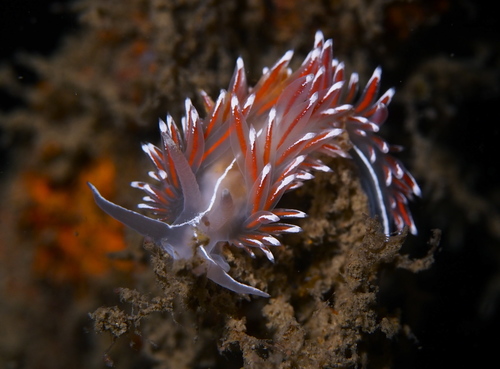
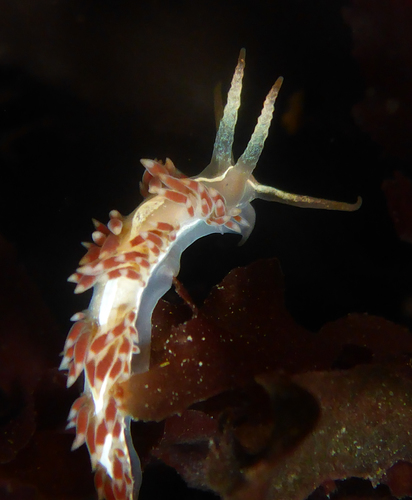
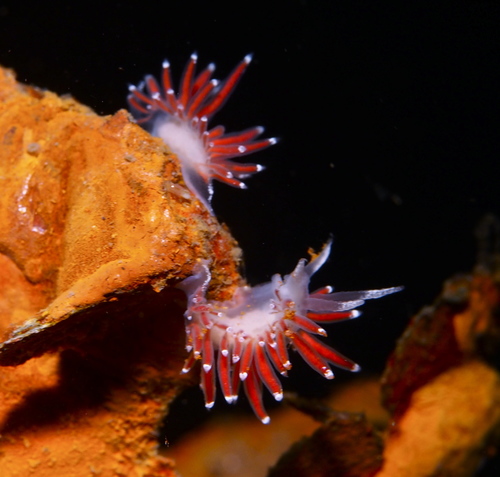
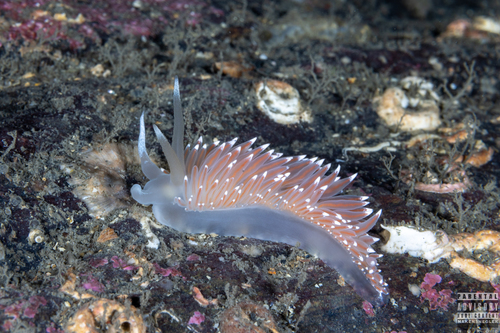
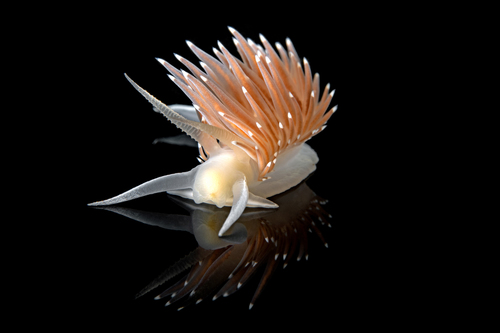
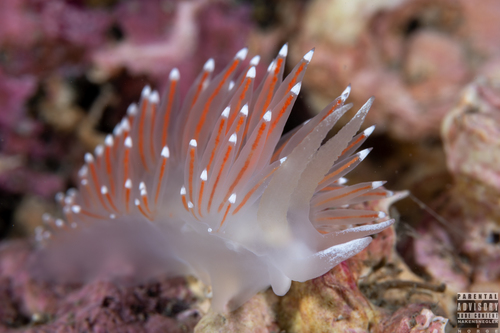
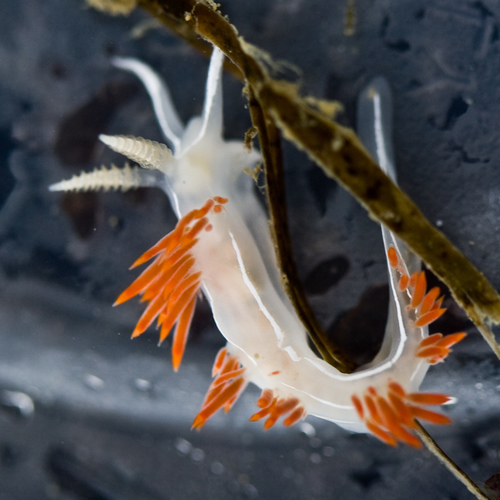
Coryphella trilineata (O'Donoghue, 1921) reaches 5–20 mm in length, with a maximum recorded length of 35 mm. It has 32–34 conical cerata, all located behind the rhinophores, that measure 1–2 mm long. Its rhinophores do not contract, have blunt ends, and are perfoliate. The genital pore sits on the right side of the body, toward the head. This species resembles Coryphella verrucosa, Coryphella lineata, and Pacifia goddardi, but can be told apart by its perfoliate rhinophores, distinct radula, and three lateral stripes. Coryphella trilineata occurs in the intertidal zone along the Eastern Pacific coast, ranging from Vancouver Island in the north to the Coronado Islands in the south. Confirmed specific locations include Dillon Beach, Point Pinos, Monterey Bay, the area near Waddell Creek, and Point Cabrillo. It can be found at depths down to 27 m, and lives on hydroids, eelgrass, or macroalgae. This nudibranch feeds on hydroids, including species in the order Leptothecata, as well as Tubularia spp., Eudendrium californicum, and Ectopleura crocea. The amphipod Podocerus cristatus is thought to mimic Coryphella trilineata (along with other species) due to the amphipod's very similar coloration. This is hypothesized to be an example of Batesian mimicry, because Coryphella trilineata has cnidosacs that deter predators. Like other nudibranchs, Coryphella trilineata lays eggs in a twisted ribbon-shaped mass. This species produces white eggs, with approximately 600 to 700 individual egg capsules per 2 mm of ribbon. Each capsule holds 1 to 2 embryos. The egg ribbon is very thin, and anchors to substrates such as the blades of Zostera marina. Embryo development begins immediately after the egg mass is laid. At a temperature of 16 °C (61 °F), embryos reach the gastrula stage within about 54 hours. They develop into trochophore larvae, with cilia and statocysts, within the following day. Before hatching, they also develop a foot and shell-secreting glands. Once the shell begins forming, embryos are at the veliger larval stage and hatch from the egg ribbon. Newly hatched larvae have long cilia, which they use for swimming and capturing phytoplankton for food. Their coiled larval shell is approximately 0.1 mm long, and no eyespots are present.