About Coryphantha sulcata (Engelm.) Britton & Rose
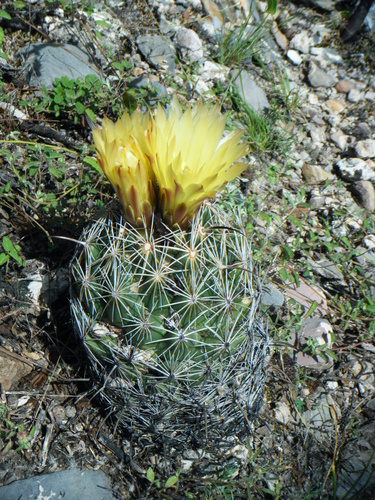
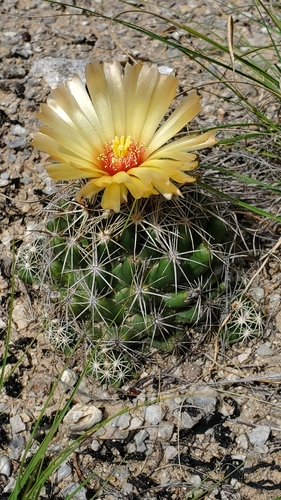
The cactus Coryphantha sulcata may have either branched or unbranched bodies, and typically forms clumps. As is characteristic of species in the genus Coryphantha, its body surfaces are divided into conical tubercles with rounded tops, which resemble closely packed green chili pepper bottoms. Each tubercle is topped by an areole, the small spot from which a cluster of slender, stiff spines grows. Each areole produces between 9 and 18 spines. These spines are yellowish or pinkish when young, and later turn gray to nearly white with dark reddish brown or black tips. The spines come in two distinct types. There are 0 to 4 central spines, of which at least one grows straight up from the surface of the areole, while any other present central spines grow at an oblique angle. There are also 8 to 15 radial spines, which measure 9–16 mm (0.35–0.63 in) long, are stout, radiate outward, and lie close to the cactus body surface. Its flowers grow at or very near the apex of the cactus body, and measure 40 mm–60 mm × 35 mm–55 mm (1.6 in–2.4 in × 1.4 in–2.2 in) in size. The flower tepals are golden yellow, or more rarely greenish yellow, with bright red, or more rarely brownish red or greenish, bases. The flower stigma has 7–10 lobes, and is whitish or greenish yellow. The fruits of Coryphantha sulcata are usually green when immature, and become dull red and broadly egg-shaped when mature. This species grows in Texas in shrublands and savannas, in gravelly, sandy to clayey soils, at elevations ranging from 300–1,100 m (980–3,610 ft). Research-grade observations documented on the iNaturalist species page for Coryphantha sulcata show this taxon occurs in a somewhat narrow band in Texas, extending from near the Oklahoma border north of the Dallas-Fort Worth area south-southwest to the Mexican border around Del Rio, and continuing into the northeast Mexican states of Coahuila, Nuevo León and Tamaulipas.