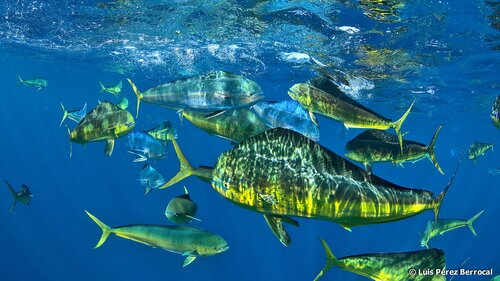
About Coryphaena hippurus Linnaeus, 1758
Coryphaena hippurus, commonly called mahi-mahi, have compressed bodies and one very long dorsal fin that extends from the head almost to the tail fin. Mature males have a distinctive protruding forehead, which grows larger as the fish matures and often extends well above the main streamlined body, shaped by the back musculature. This forehead hump is a sexually dimorphic feature, while females have a rounded head. Mahi-mahi have sharply concave caudal and anal fins. They are known for their dazzling coloration: their sides are golden, with bright blues and greens covering their sides and back. Their pectoral fins are iridescent blue, and their broad flank is golden. Out of water, this fish frequently changes color, shifting through several hues before finally fading to a muted yellow-grey after death; this color change gives the fish its Spanish name dorado, meaning golden. For reproduction, both male and female mahi-mahi reach sexual maturity in their first year, most commonly between 4 and 5 months old. They can spawn once they reach a body length of 20 cm (7.9 in). Females may spawn two to three times per year, and produce between 80,000 and 1,000,000 eggs per spawning event. In waters with a temperature of 28 °C (82 °F), mahi-mahi larvae are present year-round, with larger populations detected in spring and fall. Mahi-mahi mostly live in surface water. Their flesh is grey-white when raw, and cooks to an appealing solid white with a clean, non-fishy flavor. There are different environmental and food safety ratings for mahi-mahi depending on how it is caught. Monterey Bay Aquarium lists US Atlantic-caught mahi-mahi as a best choice, the highest category in its three-tiered environmental impact rating system. The aquarium advises avoiding imported longline-caught mahi-mahi, but rates troll-caught and pole-and-line caught imported mahi-mahi as a good alternative. The Natural Resources Defense Council classifies mahi-mahi as a moderate mercury fish, which is its second-lowest category out of four, and recommends eating no more than six servings per month. Mahi-mahi is also a common carrier of ciguatera poisoning. Even though it is a very popular food fish across much of the world, there are confirmed reports of ciguatera poisoning in humans who have consumed this fish. Ciguatera poisoning occurs when toxins called ciguatoxins and maitotoxin accumulate in the fish's flesh over time. These toxins are produced by Gambierdiscus toxicus, which grows alongside marine algae; mahi-mahi ingest the toxin accidentally when feeding. Mahi-mahi naturally have high levels of histidine, which is converted to histamine when bacteria grow during improper storage or processing. Cooking, smoking, or freezing cannot eliminate this histamine. This histamine buildup causes a foodborne illness called scombroid food poisoning, which also affects other fish including tuna, mackerel, sardine, anchovy, herring, bluefish, amberjack and marlin. Scombroid poisoning symptoms match those of histamine intolerance, and may include flushed skin, headache, itchiness, blurred vision, abdominal cramps, and diarrhea. Symptoms typically onset 10 to 60 minutes after eating contaminated mahi-mahi, and can last up to two days. Rarely, affected people may experience breathing problems similar to allergic asthma, or an irregular heartbeat. Diagnosis of this illness is usually based on symptoms, and can be supported by a normal blood tryptase result.

