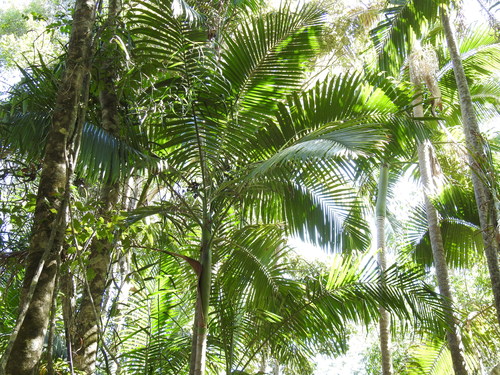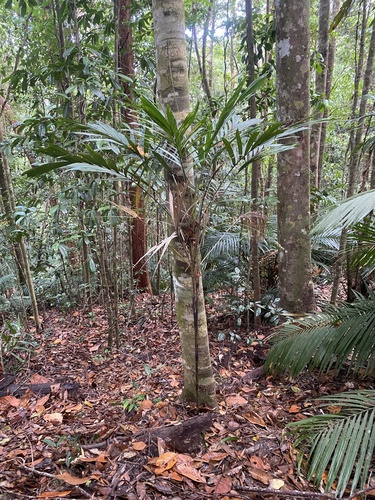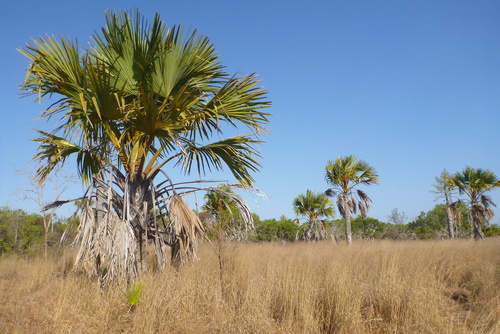
About Corypha utan Lam.
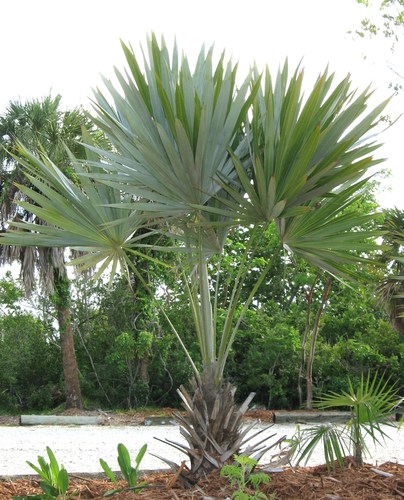
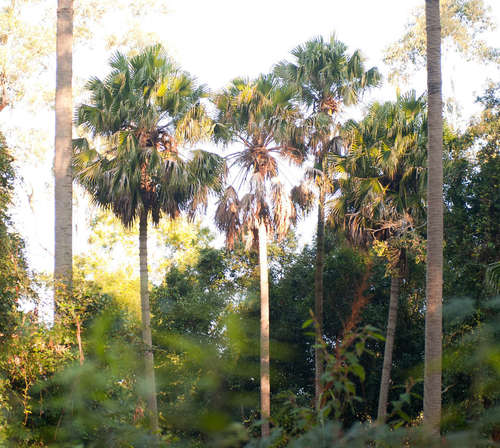
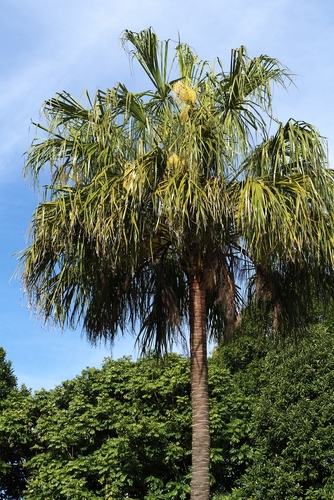
This species, Corypha utan Lam., can grow up to 20 metres (66 feet) tall. On Queensland's Cape York Peninsula, its trunk can reach up to 1.5 meters (4 feet 11 inches) thick, a size only exceeded by Borassus aethiopum and Jubaea chilensis. It produces palmate fronds that are 4 to 6 m (13 to 20 ft) long. Like all other palms in the genus Corypha, this species is monocarpic: it flowers just once at the end of its lifespan, growing a massive inflorescence up to 5 m tall that holds up to one million flowers. Corypha utan is distributed across a range that starts in the Assam region of India, extends through Indochina, Malaysia, and Indonesia to the Philippines and New Guinea, and reaches south to Australia's Cape York Peninsula. It grows along watercourses, on floodplains, and in grasslands. The Palm and Cycad Societies of Australia note that on Cape York, Corypha utan is undoubtedly one of the most imposing species in Australian palm flora, due to its massive pachycaul trunks and its spectacular hapaxanthic flowering and fruiting. Several parts of the palm are edible. Starch from its trunk can be eaten raw or cooked, and the tip-top of the palm is also edible. Beating the flowering stalks produces usable liquid, and the nut kernels are edible as well. In Lamakera, the leaves of this palm (called ketebu locally) are processed into fibres, which are then woven with sea hibiscus bark to create rope for whaling harpoons. In the Philippines, where this species is locally known as buri or buli, its leaves are widely used for weaving fans, baskets, and mats. On Isla Verde in Batangas, where Corypha utan grows abundantly, sap from the palm is extracted and cooked to make a sweet local delicacy called "Pakaskas".