About Corypha umbraculifera L.
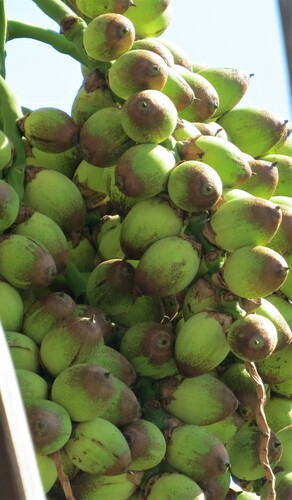
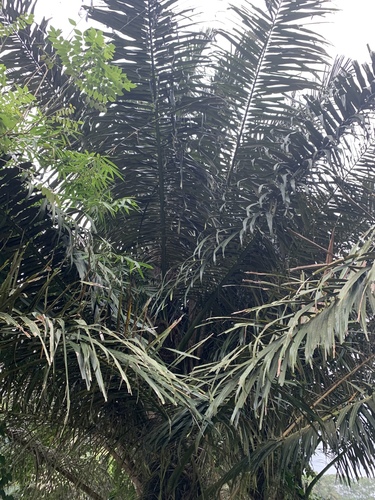
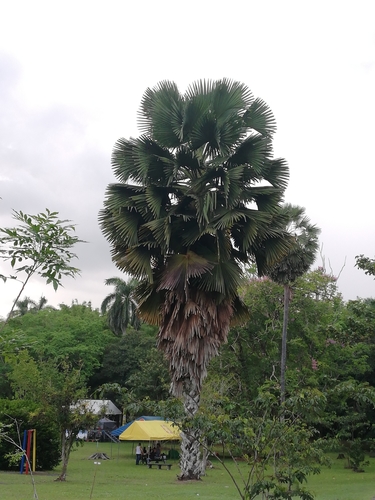
Corypha umbraculifera L., commonly called the talipot palm, is one of the world's largest palm species. Individual specimens can grow up to 25 m (82 ft) tall, with stems reaching up to 1.3 m (4.3 ft) in diameter. It is a fan palm belonging to the Arecaceae tribe Corypheae, and produces large palmate leaves up to 5 m (16 ft) in diameter. Each leaf has a petiole up to 4 m (13 ft) long, and can hold up to 130 leaflets. The talipot palm bears the largest overall inflorescence of any plant, with an inflorescence length of 6–8 m (20–26 ft). This branched inflorescence forms at the top of the trunk and holds between one and several million small flowers. This is distinct from Amorphophallus titanum (titan arum, family Araceae), which has the largest unbranched inflorescence, and Rafflesia arnoldii, which has the world's largest single flower. The talipot palm is monocarpic, meaning it flowers only once, when it is between 30 and 80 years old. After flowering, it takes approximately one year for fruit to mature. The plant produces thousands of round, yellow-green fruit 3–4 cm (1–1.5 in) in diameter, each containing a single seed. The entire plant dies after fruiting. The talipot palm is cultivated in South India and Sri Lanka. It is also cultivated in the Southeast Asian countries of Cambodia, Myanmar, and Thailand, as well as the Andaman Islands, and is grown sparsely in China. Historically, cultures across South Asia and Southeast Asia used an iron stylus to write on talipot palm leaves to create palm leaf manuscripts. In the Philippines, this species is locally known as buri or buli. Its leaves are also commonly used for thatching, and its sap can be tapped to produce palm wine. In South India, leaves of the talipot palm are used to make umbrellas for agricultural workers. It has many regional common names across South Asia: in Malayalam it is called kudapana (കുടപ്പന), in Odia it is called talo (ତାଳ), in Telugu it is called sreetalam (శ్రీతాళం), and in Tamil it is called kudaipanai (குடைப்பனை) — all of these names translate to umbrella palm. Local Sinhalese people in Sri Lanka call the plant tala (තල). In Cambodia, the palm is known as tréang; it was also called latanier by French people. As noted, it was extensively used in the past to write religious manuscripts. More recently, traditional healers and soothsayers have used prepared palm leaf media from this species. Mature talipot palm leaves are used to make thatches, mats, and hats. The leaf petioles can be used to manufacture canes, arrows, and netting needles. At low tide, fishers use the plant's fruit to stupefy fish.