About Corynaea crassa Hook.fil.
Corynaea crassa Hook.fil. is a root hemiparasite that parasitizes a broad variety of plants. It does not need sunlight to gather nutrients, so it lacks leaves. Like other members of the Balanophoraceae family, its vegetative body is made up of an accumulation of plant tissue called a haustorial tuber. The plant’s inflorescences develop directly from this haustorial tuber. The size of the haustorial tuber is directly correlated with the diameter of the host root it draws nutrients from, and the number of inflorescences the tuber produces is directly correlated with the diameter of the tuber itself. Inflorescence emergence is seasonal, and individual flowers are pollinated by insects from the orders Hymenoptera and Diptera.
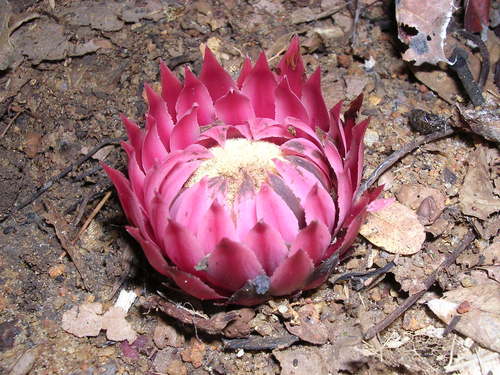
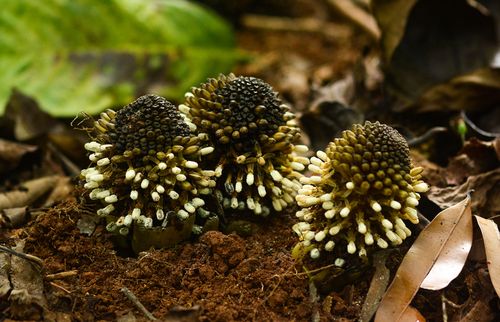
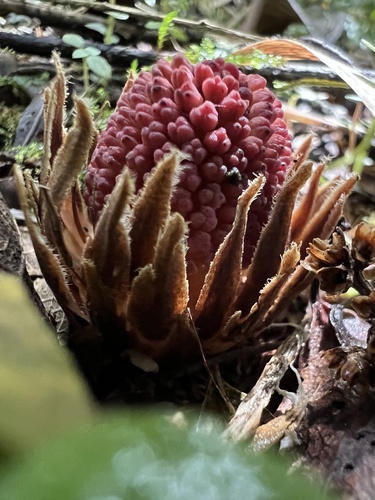
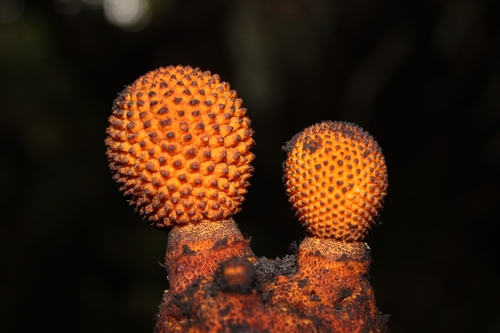
The rhizome of C. crassa is irregularly shaped with multiple lobes, and it turns rust-colored when dried. Its inflorescence is typically pink, and can range in color from yellowish-brown to deep purple. The peduncle, the inflorescence stalk, has an irregular short lobed sheath at its base, and measures 1.5–2.5 centimetres (0.59–0.98 in) in length. The flower head is globose, tapering to a fusiform shape, with a length of 2–4 centimetres (0.79–1.57 in) and a diameter of 1.5–2.0 centimetres (0.59–0.79 in). Individual fruits are obovoid (egg-shaped), and measure around 1.5 millimetres (0.059 in) long by 1 millimetre (0.039 in) wide.
Documented host plants include Bocconia frutescens, Cayaponia sp., Palicourea sp., and Verbesina sp. from a study conducted in Costa Rica, where B. frutescens was the most commonly parasitized species, hosting 79.4 percent of all recorded tubers. Another source records Myrcia as a host in Costa Rica. C. crassa is also known to parasitize bamboo shoots and Eupatorium angulare. Parasitized plant genera belong to at least four distinct plant families: Asteraceae, Cucurbitaceae, Papaveraceae, and Rubiaceae. In Guaramacal, Venezuela, the species has been found growing in association with Renealmia (Zingiberaceae), but the nature of this relationship is currently unknown.
Corynaea crassa is distributed across South and Central America, and has been recorded in the countries of Bolivia, Colombia, Costa Rica, Ecuador, Panama, Peru, and Venezuela. In Peru, it occurs in the provinces of Amazonas, Cajamarca, Cusco, La Libertad, Lambayeque, and Pasco. It grows in a range of native habitats including primary forest, secondary forest, cloud forest, oak forest, and stream banks. In one Colombian locality, it occurs between 1,300 metres (4,300 ft) and 3,000 metres (9,800 ft) elevation. On Volcán Barú, Panama, plants have been recorded at elevations between 3,500–4,000 metres (11,500–13,100 ft). The overall estimated elevation range for the species is 1,250–3,600 metres (4,100–11,810 ft).
In Peruvian folk medicine, Corynaea crassa is commonly used as a male aphrodisiac and anti-inflammatory. It is held to have anti-aphrodisiac properties if used by women. Its tubers are often sold dried or powdered in markets. Ethanolic extracts of Corynaea crassa have shown biological activity against the bacterium Staphylococcus aureus. The Philippine Food and Drug Administration has issued an advisory for products containing C. crassa extracts, due to the presence of adulterated Tadalafil. Chemical analysis of dried tubers via chromatography, steroid elucidation, and X-ray crystallography has detected anthocyanins, cardiotonics, flavonoids, tannins, triterpenes, and steroids, with no alkaloids present. This analysis found a previously unobserved 1:1 ratio of the triterpenes lupenone with β-amyrone, and lupeol with β-amyrine. The detected compounds matched those found in other plants with reported aphrodisiac properties. The chemical composition of C. crassa tubers varies depending on the host species the plant parasitizes, and the wide range of different hosts across the species’ distribution leads to differing chemical compositions in tubers found in Peru and Ecuador.