About Corynactis viridis Allman, 1846
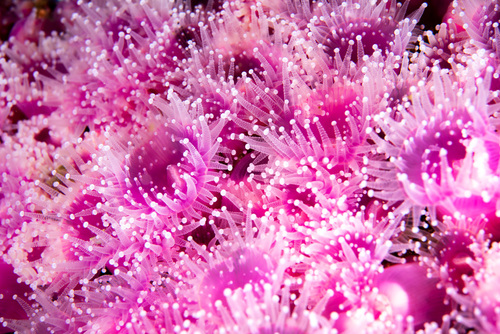
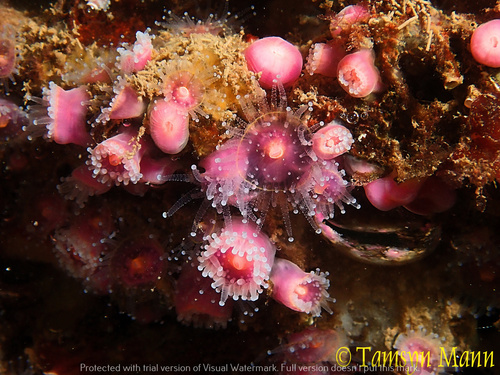
Corynactis viridis Allman, 1846 is a sea anemone with a smooth, roughly cylindrical column that is slightly wider at the base and oral disc than at its center. Its base can reach around 10 mm (0.4 in) in diameter and is often ragged in outline. This irregular shape occurs because the species reproduces by longitudinal fission, and the two new individuals sometimes remain partially connected after division. These anemones typically live in dense aggregations, but each individual attaches only lightly to its substrate and can drift away. Their tentacles range from short to medium length, have tapering shafts and knobbed tips, and are arranged in two whorls. The outer whorl holds longer tentacles, while the inner whorl holds a greater number of tentacles. This anemone species has very variable colouring. Its column, tentacles, and knobbed tips can show contrasting shades of white, pink, orange, red, and green. The oral disc is usually translucent, and can be either plain or marked with white patches. One common colour form is entirely emerald green, with brown tentacles that have crimson tips, and often has a crimson marginal ring around the oral disc. Corynactis viridis is found in the northeastern Atlantic Ocean and the Mediterranean Sea. Its confirmed range includes Scotland, Ireland, the western and southern coasts of England and Wales, southwestern continental Europe, and all countries that border the Mediterranean Sea. It occurs from the lower shore down through the sublittoral zone to depths of approximately 80 m (260 ft). It inhabits dimly lit locations on rock, particularly favouring vertical rock faces, overhangs, and caves, and often grows into dense patches. In addition to standard sexual reproduction, Corynactis viridis reproduces asexually via longitudinal fission. During this process, two sections of the anemone pull away from each other, tearing the animal into two fragments. Both fragments then heal and develop into fully functional new individuals. This method of reproduction can make new individuals difficult to distinguish from one another.