About Corymbia opaca D.J.Carr & S.G.M.Carr
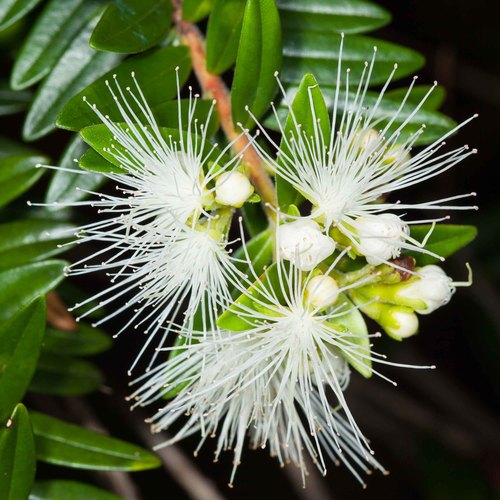
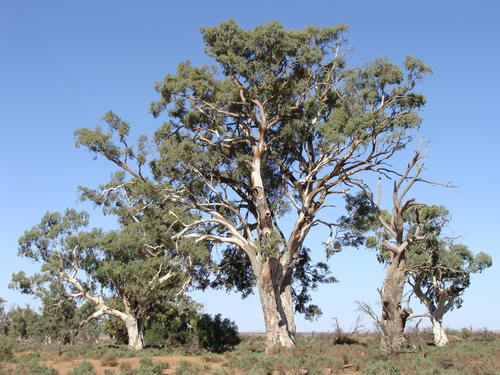
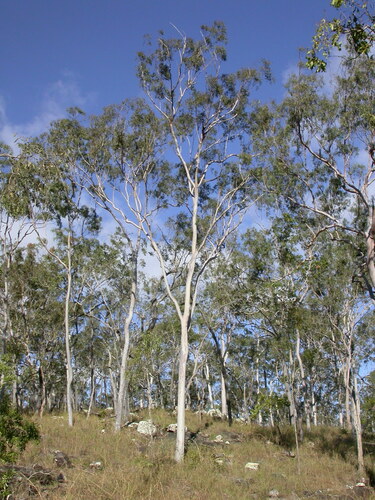
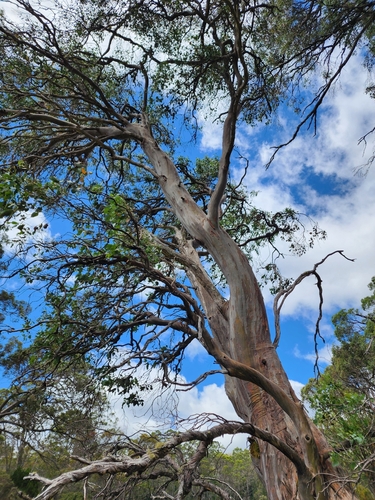
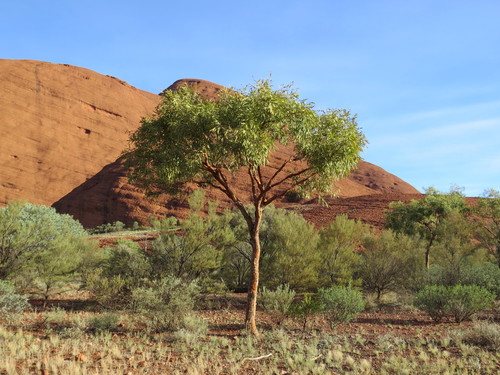
Corymbia opaca (first described by D.J.Carr & S.G.M.Carr) is usually a tree, rarely a mallee, that typically grows to 3–15 metres (9.8–49.2 feet) in height and forms a lignotuber. Some or all of its trunk is covered in rough, tessellated, reddish-brown bark. Young plants and coppice regrowth have stalked, egg-shaped to lance-shaped leaves that are 40–90 millimetres (1.6–3.5 inches) long, 11–28 millimetres (0.43–1.10 inches) wide, and have a small point at the tip. Adult leaves are arranged alternately, are the same shade of green or greyish-green on both sides, are lance-shaped, 110–190 millimetres (4.3–7.5 inches) long, 14–32 millimetres (0.55–1.26 inches) wide, and have a petiole 13–25 millimetres (0.51–0.98 inches) long. Flower buds are arranged in groups of seven on an unbranched, cylindrical peduncle 8–15 millimetres (0.31–0.59 inches) long, with individual buds attached to pedicels 3–7 millimetres (0.12–0.28 inches) long. Mature buds are club-shaped, with an oval floral cup about 7 millimetres (0.28 inches) long and 7–8 millimetres (0.28–0.31 inches) wide, and a saucer-shaped operculum that has a central point, is about 2 millimetres (0.079 inches) long, and 6–7 millimetres (0.24–0.28 inches) wide. The flowers are creamy white, and the fruit is an urn-shaped capsule 16–24 millimetres (0.63–0.94 inches) long and 12–16 millimetres (0.47–0.63 inches) wide.
This species occurs in scattered populations in desert areas: the southwest Kimberley, Pilbara and northern desert regions of Western Australia; central and southern parts of the Northern Territory, particularly around Alice Springs; and the Mann and Musgrave Ranges in the far northwest of South Australia. It most commonly grows in sandy soils in alluvial areas and on lower hillslopes.
Corymbia opaca is a bloodwood tree, and occasionally a piece of its bark will shed, opening a wound through which blood-like kino sap flows. The sap flows until it crystallises, covering the hole in the bark. Australian Aboriginal people collect this crystallised substance for use as bush medicine: they apply the sticky gum directly to sores or cuts, where it acts as an antiseptic. Dried sap can be crushed into powder and boiled in water to use as an antiseptic wash. Aboriginal people also use the bloodwood sap to tan kangaroo-skin waterbags. Bush coconuts, a type of bush tucker that forms when an insect creates a gall on the tree, are collected from C. opaca. The tree's roots store water, and Aboriginal peoples dig up the roots to drain the stored water into containers for use.