About Corymbia clarksoniana (D.J.Carr & S.G.M.Carr) K.D.Hill & L.A.S.Johnson
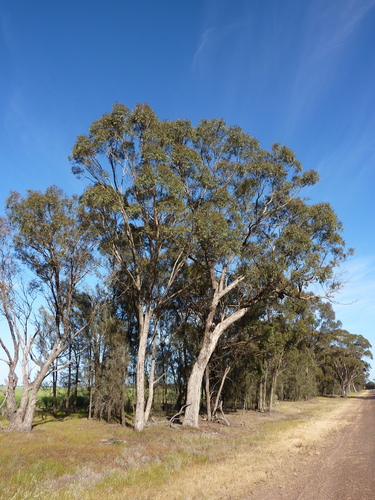
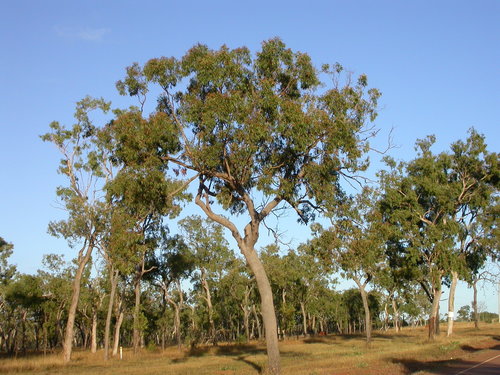
Corymbia clarksoniana (D.J.Carr & S.G.M.Carr) K.D.Hill & L.A.S.Johnson is a medium-sized bloodwood tree that typically grows up to 20 metres (66 feet) tall. It retains persistent, tessellated red-brown to grey-brown bark across its entire trunk and branches. Dull grey-green adult leaves are arranged disjunctly, shaped narrow lanceolate to lanceolate, and taper at their base. The leaves are thin and discolorous, measuring 12 to 20 cm (4.7 to 7.9 in) long and 14 to 35 mm (0.55 to 1.38 in) wide, with obscure lateral veins. It produces terminal compound inflorescences, arranged in groups of seven per umbel on pedicels 0.3 to 1 cm (0.12 to 0.39 in) long. Mature buds are obovoid to pyriform, 0.7 to 1.2 cm (0.28 to 0.47 in) long and 0.4 to 0.8 cm (0.16 to 0.31 in) wide, with a rounded to conical, beaked operculum, and the tree bears white flowers. Flowering can start as early as January, but typically occurs between March and August. After flowering, it develops pedicellate fruits that are urceolate to barrel-shaped. The fruits measure 1.2 to 2.5 cm (0.47 to 0.98 in) long and 0.9 to 1.6 cm (0.35 to 0.63 in) wide, with a descending disc and three or four enclosed valves. The reddish-brown seeds inside the fruit are ellipsoidal, have a terminal wing, and are 9 to 11 mm (0.35 to 0.43 in) long. This tree is endemic to eastern Queensland and far northern New South Wales in Australia, where it grows on inland plains as part of grassy woodland and forest communities, in sand and sandy loam soils. It can also occur in skeletal soils on ridges and hill tops. Hill and Johnson originally described C. clarksoniana as endemic only to Queensland, and recognised C. clarksoniana, C. dolichocarpa and C. maritima as three distinct species, with intermediate populations between them. They recorded C. dolichocarpa growing from Charters Towers, Queensland to near Narrabri, New South Wales, and C. maritima growing in near-coastal areas from Cardwell to the Whitsundays. Currently, the Australian Plant Census treats all three taxa as a single species.