About Corylus americana Walter
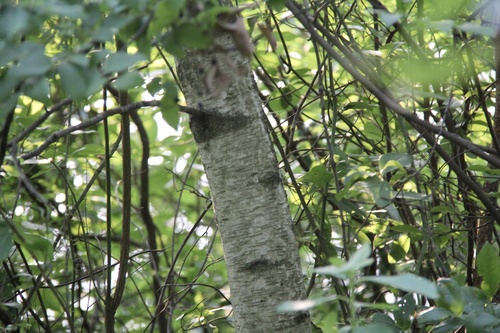
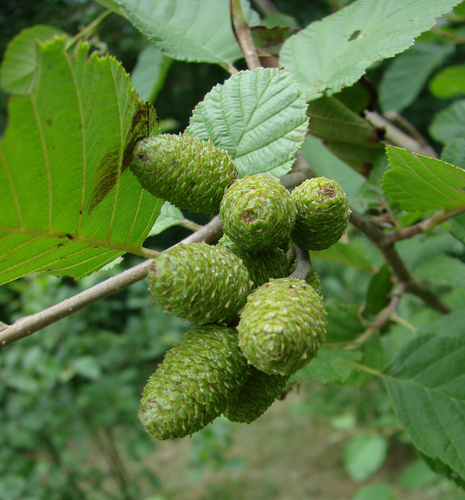
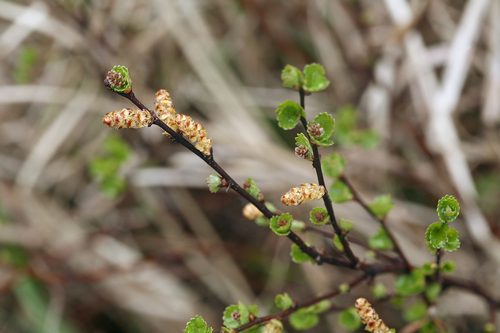
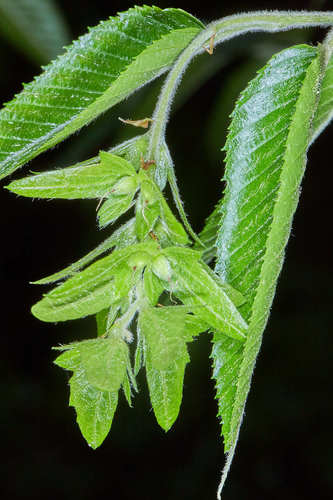
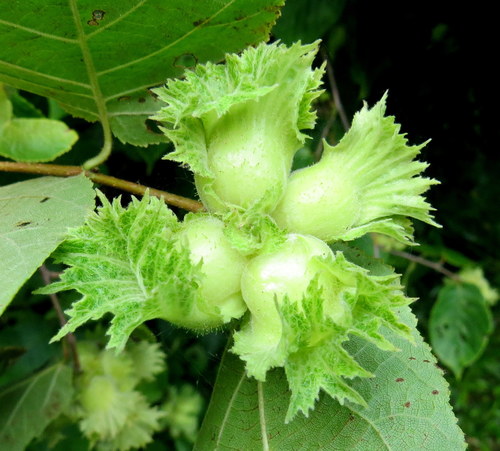
Corylus americana Walter, commonly known as American hazelnut, is a medium to large shrub that can sometimes grow into the shape of a small tree. It reaches a height of roughly 2.5 to 5 m (8 to 16 ft), with a crown spread of 3 to 4.5 m (10 to 15 ft). It is often multi-stemmed, with long outward-growing branches that form a dense spreading or rounded shape. It spreads by producing suckers from underground rhizomes located 10 to 15 cm (4 to 6 in) below the soil surface. It blooms from very early to mid spring. It produces hanging male (staminate) catkins 4 to 8 cm (1+1⁄2 to 3+1⁄4 in) long, and clusters of 2–5 tiny female (pistillate) flowers. Female flowers are enclosed in protective bud bracts, with red styles protruding from the tip. Male catkins develop in the fall, and persist through the winter. Each male flower on a catkin has a pair of bracts and four stamens. American hazelnut produces edible nuts that mature between July and October. Each nut is enclosed in two leaf-like bracts with irregularly laciniate margins. In its ecology, the nuts of American hazelnut are a seasonal mast food source for squirrels, whitetail deer, foxes, ruffed grouse, northern bobwhites, pheasants, turkey, woodpeckers, and other animals. Its leaves are browsed by whitetail deer, moose, and rabbits. Male catkins are a staple winter food source for ruffed grouse and turkey. Low-hanging American hazelnut shrubs provide habitat for many animal species. The nuts of American hazelnut are edible raw, though they are smaller than the more commonly cultivated filberts (Corylus maxima, Corylus avellana, and their hybrids). They have an oil content comparable to that of C. avellana, which makes them well-suited for culinary oil production. Native Americans used Corylus americana for a range of medicinal purposes, including treatment of hives, biliousness, diarrhoea, cramps, hay fever, hemorrhages, to aid childbirth, build prenatal strength, help with teething, induce vomiting, and heal cuts. Corylus americana is cultivated as an ornamental plant for native plant gardens, and for wildlife gardens to attract and support local fauna. Cultivated hybrids of Corylus americana and Corylus avellana exist, bred to combine the larger nuts of C. avellana with C. americana's resistance to the North American fungus Cryptosporella anomala. It is a medium to fast-growing species that produces moderate numbers of suckers, eventually forming a multi-stemmed clump. It adapts well to a wide range of soil pH levels and soil types, but grows best in well-drained loam. American hazelnut prefers full sun for optimal growth and development. While it can grow and persist in partial shade, plant density and fruit production are greatly reduced in these conditions.