About Corydalus cornutus (Linnaeus, 1758)
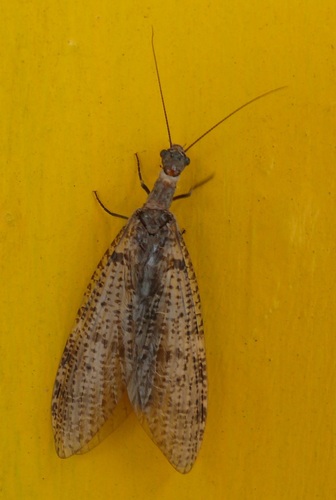
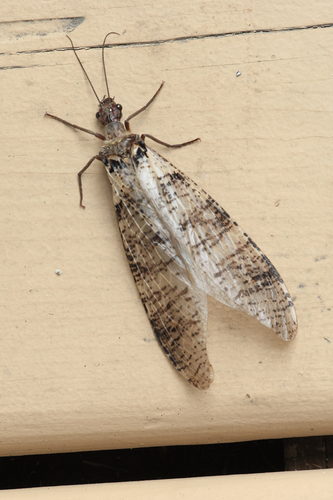
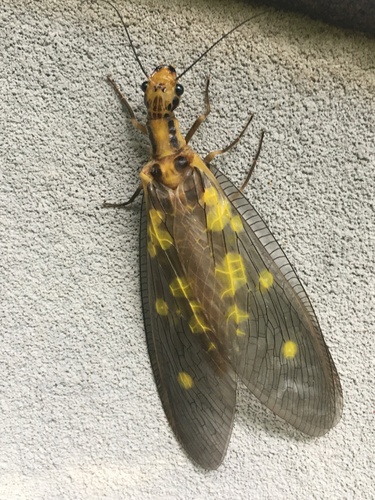
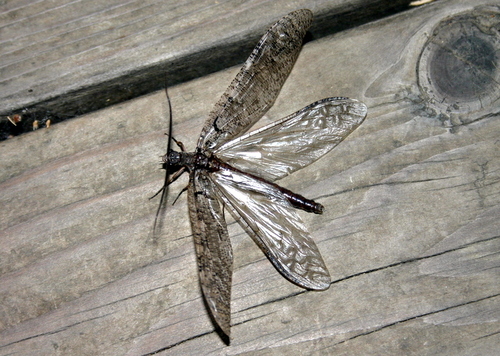
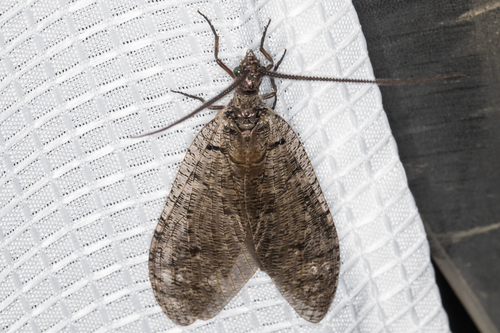
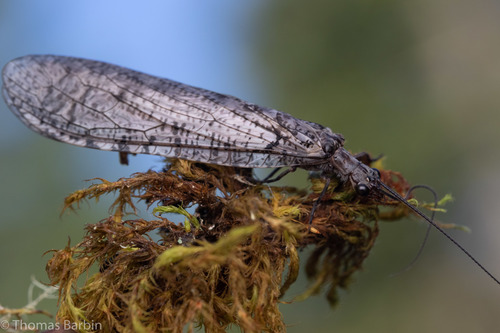
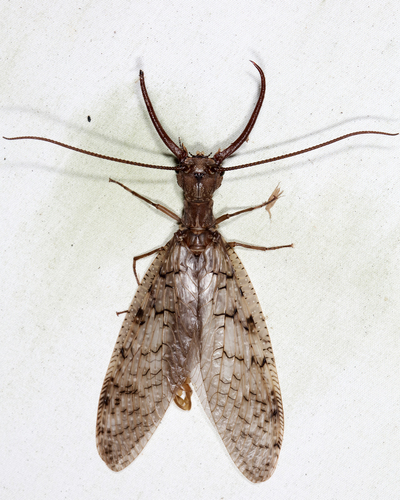
Corydalus cornutus, the eastern dobsonfly, has the following life stages and characteristics. Its eggs are grey, cylindrical, and measure about 1.4 millimetres long by 0.5 millimetres wide. Eggs are laid in groups of approximately 1,000, stacked in three layers. The female uses the tip of her abdomen to apply a clear protective fluid to the egg pile; this fluid dries white, and the resulting egg mass is said to resemble a bird dropping. Larvae (called hellgrammites) grow up to 90 millimetres long, and are light brown covered in tiny dark brown microspines. The thorax bears three pairs of legs, and each thoracic segment is covered by a tough, dark-coloured dorsal plate. The first eight abdominal segments have lateral tactile filaments, and the first seven have tufted tracheal gills. Larvae also have spiracles that let them breathe both in water and on land. Two prolegs sit at the tip of the abdomen; each proleg has a dorsal filament and a pair of terminal hooks that let the larva anchor itself in fast-flowing water. Larval mandibles are sclerotised and powerful. Pupae are orange with dark patches on the upper side of the abdomen, and are covered in minute bristles. Developing limbs, wings, and antennae project outside the pupal covering. Adult eastern dobsonflies are large insects, reaching up to 140 millimetres in total length with a wingspan of up to around 130 millimetres. Females have short, powerful mandibles similar in size to those of the larva, while males have sickle-shaped mandibles up to 40 millimetres long – half the total length of the male's body. Antennae are long and segmented. Wings are greyish, translucent, heavily veined, and often mottled with white dots. When at rest, wings are folded flat over the insect's back and extend past the tip of the abdomen. This species is distributed across most of eastern North America, and is typically found near the swift, unpolluted streams where its aquatic larvae develop. For its life cycle: eggs are usually laid near the water's edge, on rocks or overhanging foliage, and hatch at night one to two weeks after being laid. Newly emerged larvae fall or crawl into the stream, then move to fast-flowing, stony-bottomed sections. Hellgrammites hide under stones, where they catch and eat soft-bodied invertebrates. They grow slowly, molting ten to twelve times before reaching their maximum length of up to 90 millimetres; larger hellgrammites are formidable fearsome predators with well-developed jaws. After one to three years of development, when ready to pupate, larvae leave the water and travel up to 15 metres to find a suitable spot under a rock, log, or leaf litter. Mass emergence of hellgrammites may occur within a few days of one another. Each larva digs a hole in moist soil to create a small, smooth-walled chamber. After a several-day prepupal stage, the larva molts and becomes a pupa. In some regions, adults emerge 7 to 14 days after pupation, while in other regions pupae overwinter before adult emergence. Once fully developed, adults dig their way up to the soil surface. Adults are not thought to feed, and instead spend their time in dense vegetation near streams. They are most active at night and are attracted to lights. After mating and laying eggs, adults usually die within one week.