About Corydalis micrantha subsp. australis (Chapm.) G.B.Ownbey
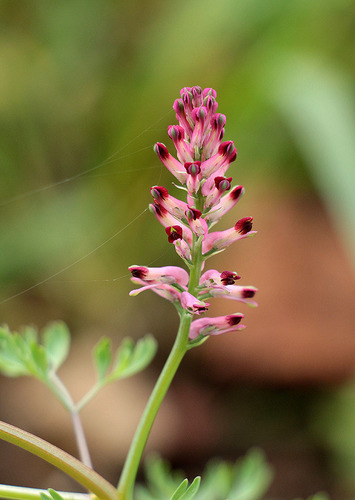
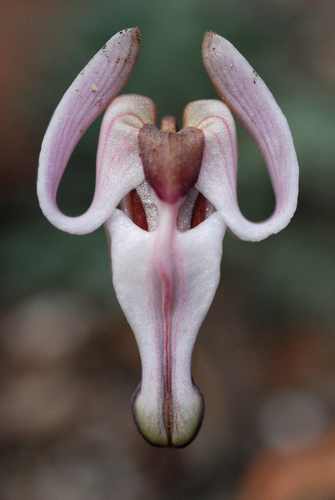
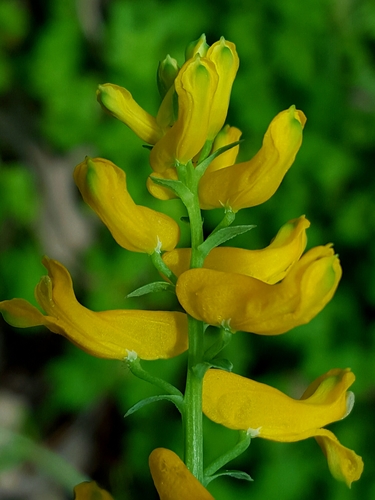
Corydalis micrantha is a species in the genus Corydalis, a group that contains approximately 300 species. Corydalis micrantha is divided into three subspecies: C. micrantha subsp. micrantha, C. micrantha subsp. australis, and C. micrantha subsp. texensis. For C. micrantha subsp. micrantha, a rosette of basal leaves forms that is roughly 8 inches across, and several flowering stalks grow to around 8 inches in length. Basal leaf blades can reach up to 3 inches long and 2 inches across. These basal leaves are pinnately compound, hairless, and their color ranges from dull green to greyish blue. Each flowering stalk ends in a flower raceme that can grow up to 3 inches long. The flowers have short pedicels and small bracts. Normally flowered racemes do not grow much longer than the leaves, and are often short. The flower spurs are spherical at their tips. Fruits are typically firm and usually 10–15 mm long. Each flower’s corolla has two outer petals that range from yellow to pale yellow, plus two whiter, membranous inner petals. In C. micrantha subsp. australis, normally flowered racemes often grow much longer than the leaves. The spurs are not globose at the flower tip, and this subspecies produces slender fruits that are 15–30 mm long. Its pedicels are erect, usually 2–5 mm long and 1–3 mm wide. The flower corolla is light yellow, with spurred petals 9–15 mm long. The fruit capsule is erect, with a cylindrical body around 15–20 mm long. Seeds are roughly 1.5–2 mm broad and lack a marginal ring. Its leaves are green, sometimes glaucous; stems branch from the base, and the leaves are pinnately decompound. For C. micrantha subsp. texensis, stems are usually firm and become strongly striated when dried. Foliage color ranges from green to bluish-grey, and its fruits are 25–30 mm long. Corydalis micrantha occurs primarily in the United States, where it has been recorded in Alabama, Arkansas, Florida, Georgia, Iowa, Illinois, Indiana, Kansas, Louisiana, Minnesota, Missouri, Mississippi, North Carolina, Nebraska, Oklahoma, South Carolina, South Dakota, Tennessee, Texas, and Wisconsin. Each of the three subspecies has its own specific distribution within the United States. C. micrantha subsp. micrantha is generally found in the central United States. C. micrantha subsp. australis is generally found from south-central to southern United States, and it is currently listed as an endangered species in Illinois. C. micrantha subsp. texensis occurs only in coastal south Texas. Corydalis micrantha is an annual forb/herb. Habitats for C. micrantha subsp. micrantha include open rocky woodlands, sandy savannas, ledges along lightly wooded bluffs, glades, gravelly areas alongside railroad tracks, and mulched areas around buildings. This subspecies prefers habitats with sparse ground vegetation and partial shade. C. micrantha subsp. australis typically grows from March to April. It is most often found on sandy roadsides and in sandy fields, and is very rare on rocky slopes and mountains.