About Corydalis caseana A.Gray
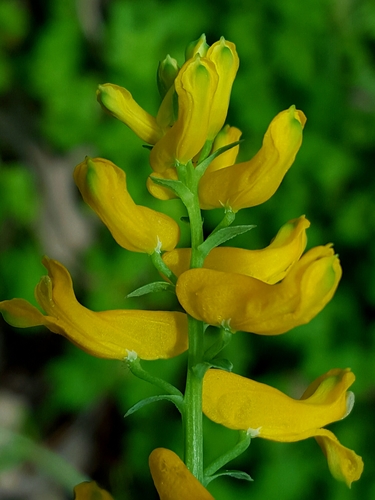
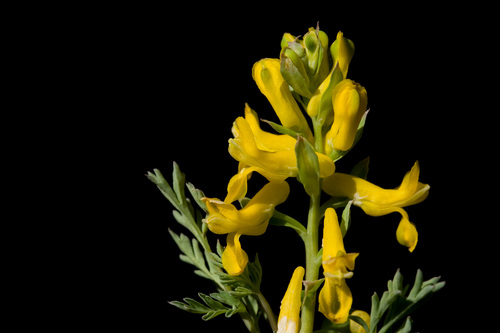
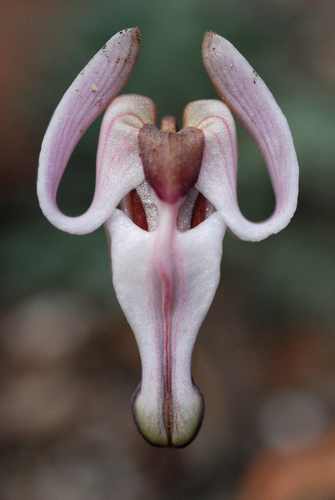
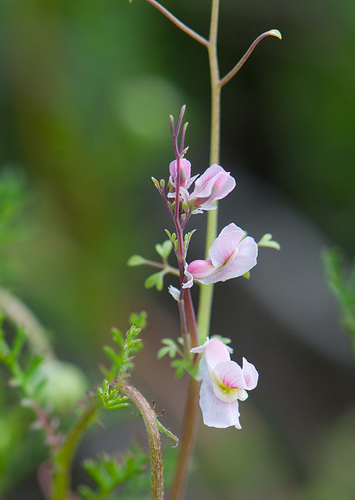
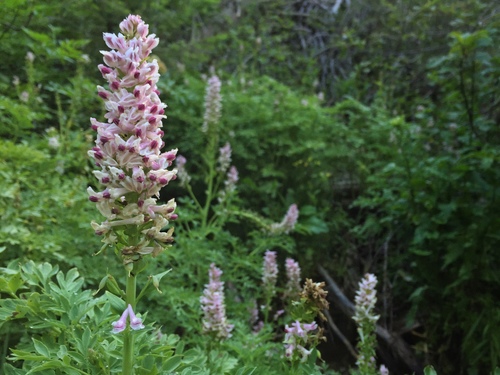
Corydalis caseana A.Gray, commonly known as Sierra corydalis, is a perennial herb. It produces one or more upright stems that typically reach 1 to 1.5 meters (3.3–4.9 ft) in height, though they can grow to almost 2.4 meters (7.9 ft). This makes it larger than any other species in the Corydalis genus, with the possible exception of Corydalis gigantea. Stems are thick, hollow, and may be either unbranched or branched toward the top. Plants grow from large, tuberous roots. Each stem bears 3 to 6 leaves, most commonly five. Leaves are glaucous, covered in a rubbable powdery white wax that gives them a gray-green color. Each leaf is compounded 2 to 4 times, resulting in a fern-like appearance. Leaves can grow up to 1 meter (3.3 ft) long; the end lobes of lower leaves are narrowly to broadly elliptic, and measure 1–5 cm long. Flowers have four petals arranged in two pairs. The two outer petals are hood-shaped; the upper outer petal bears a long, nectar-filled spur. Petals are primarily pink to white, while the inner petals have red to purple tips. The spurless outer petal is 10–15 millimeters long, inner petals are 7–12 mm long, and the slightly larger upper petal (including spur) is 16–25 mm long, with the spur itself measuring 9–16 mm. Inflorescences are spike-like; 30 to 200 flowers appear attached directly to the main stem, but each actually grows from a 3–5 millimeter long pedicel. Fruits are ellipsoid capsules 10–15 mm long and 3–5 mm wide. The many seeds inside each capsule are roughly 2.5 mm in diameter, with a warty surface. Sierra corydalis is native to seven western U.S. states. It grows primarily in areas with poor, constantly moist mineral soils. Sierra corydalis is very poisonous to horses. It is considered quite dangerous because horses do not avoid eating it. Symptoms including staggering, seizures, snapping of the mouth, and panting can develop within minutes of consumption.