About Corybas sanctigeorgianus Lehnebach
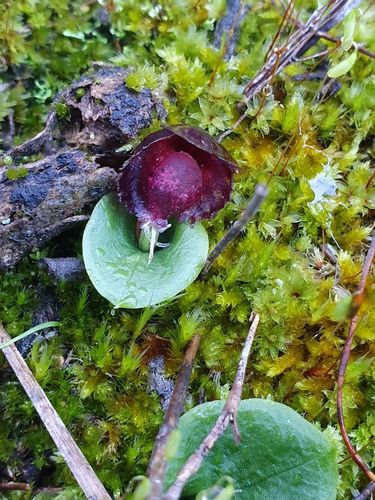
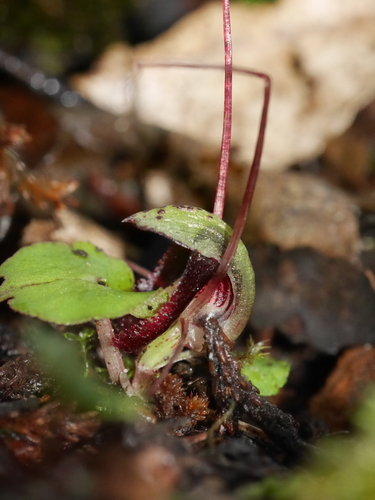
Corybas sanctigeorgianus Lehnebach is a terrestrial, perennial herb. It produces a single solitary leaf, which is kidney-shaped (reniform) to heart-shaped (cordiform), borne on a petiole 9.8–12.7 mm long. The leaf measures 10.0–13.2 mm by 14.0–19.0 mm, and has a sharp-pointed apex. This species bears a single flower, held on a small peduncle that bears a short, oval-shaped floral bract when flattened. The dorsal sepal is green, sometimes marked with maroon splotches. It arches over the labellum, with a broadly rounded apex that is sometimes mucronate, and is characteristically longer than the labellum. The lateral sepals are long and thread-like (filiform), and are crystalline white dotted with crimson specks. The petals match the lateral sepals in appearance but are slightly longer. The labellum is predominantly white marked with dark red, and may have vertical red streaks. It is covered in short trichomes, and is auriculate, forming two lobes at its base. The notch between the two basal lobes measures 1.7–2.0 mm wide. The lip is strongly downturned, folds inward to form a central groove, and has slightly cupped sides. Most of the lip margins are smooth and entire, only the tip is toothed. The column is straight, with square wings on both sides of the stigma. Flowering occurs from mid-August to September. The length of the dorsal sepal is a useful characteristic for identifying this species. Corybas sanctigeorgianus resembles Corybas hypogaeus in both flower and leaf shape. It can be distinguished from C. hypogaeus by its dorsal sepal that extends past the labellum, its straight ovary, and its predominantly white labellum (excluding the margins). It can also be told apart from Corybas trilobus by the length of its dorsal sepal, and by its white labellum rather than the translucent green labellum of C. trilobus. Corybas sanctigeorgianus is endemic to the Hunua Ranges of New Zealand's North Island. It grows in leaf litter under scrub or podocarp-broadleaved forest, in gravelly soil, or on decaying tree fern trunks.