About Corybas oblongus (Hook.f.) Rchb.f.
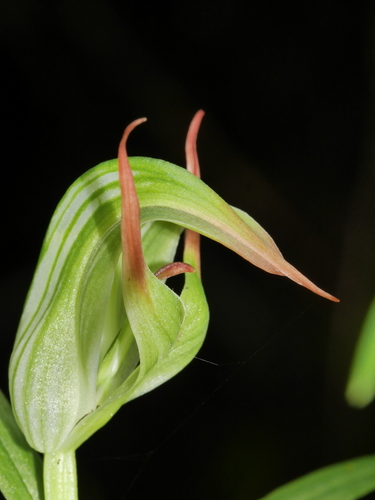
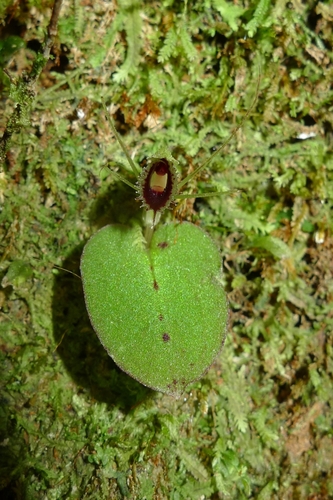
Corybas oblongus (Hook.f.) Rchb.f. is a terrestrial, perennial herb that grows a single distinctive oval, sessile leaf measuring 10–40 mm long. The leaf often has slightly undulated edges and characteristic maroon patterning, which can appear as either flecks or veining. Its upper surface is green, while the lower surface is silvery red or silvery green. The dorsal sepal is slightly longer than the labellum, broad at the apex, and forms a hood over the lip. Its color ranges from white (a rare occurrence) to pale green, flecked with purple or red. Lateral sepals are long, thread-like (filiform), and colored anywhere from crystalline white to maroon. Petals resemble the lateral sepals, but are slightly shorter. The labellum, which measures 5–10 mm long, faces horizontally or tilts slightly upwards. It is curved at the base, forming a cylindrical opening with a flared, heavily toothed (highly fimbriate) mouth. The surface of the posterior half of the labellum bears many hair-like structures that curve backwards. Flowering occurs between September and February. After flowering, the capsule develops on a peduncle that elongates as it grows, a trait shared with several other Corybas species. When not in flower, Corybas oblongus can occasionally be mistaken for the leaves of Corybas acuminatus, which also has undulated leaf margins and maroon patterning ranging from flecking to veining. The two species can generally be distinguished because C. acuminatus has heart-shaped leaves with sharply pointed tips. However, flowers may be needed for reliable identification of individuals with weakly pointed leaves. The only other Corybas species that shares a fimbriate labellum with C. oblongus is Corybas cryptanthus, which differs by being leafless and lacking chlorophyll. Corybas oblongus grows in coastal and subalpine habitats up to 1200 m above sea level, including shrubland, forests, and peat bogs. It is found on the North Island, South Island, Chatham Islands, and Antipodean Islands.