About Corybas aconitiflorus Salisb.
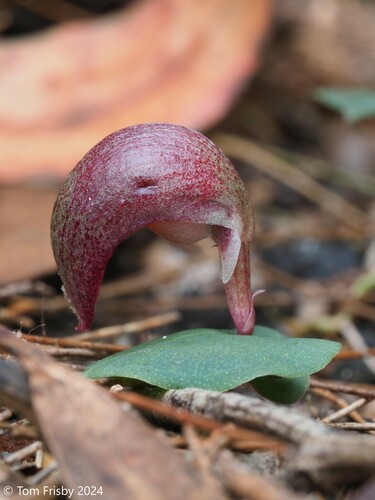
Corybas aconitiflorus Salisb. grows from a pair of small tubers, and dies back to these tubers during its dormant season. It has short, upright stems that usually bear a single flat, smooth basal leaf. The upper surface of this leaf is dark green, while the lower surface is purplish; it ranges from egg-shaped to heart-shaped, measuring 15–35 mm (0.6–1 in) long and 10–30 mm (0.4–1 in) wide. This orchid produces a single greyish to reddish purple flower that leans forward, 25–30 mm (0.98–1.2 in) long and 10–12 mm (0.4–0.5 in) wide. Its hooded dorsal sepal is 22–30 mm (0.9–1 in) long and 10–12 mm (0.4–0.5 in) wide, and covers and hides most of the rest of the flower. The lateral sepals and petals are only 1 or 2 mm (0.04 or 0.08 in) long, and look very similar to one another. The labellum is much smaller than the petals and lateral sepals, is undivided, and has in-rolled margins. The thin column is wider at its base, and has fused wings running along its length. It has persistent terminal cream-colored pollen masses called pollinia, which are attached directly to viscidia: sticky pads that adhere to pollinators. This species is pollinated by fungus gnats, but little else is known about its pollination mechanism. This is because most of the flower is hidden by the dorsal sepal, and the species is hard to cultivate. Commonly called the cradle orchid, Corybas aconitiflorus grows in heath and forest, mostly in coastal and near-coastal areas. It can be found in Queensland south from Gympie, eastern New South Wales, and south-eastern Victoria, with isolated populations in western Victoria. It also grows in northern and eastern Tasmania.