About Corvus tasmanicus Mathews, 1912
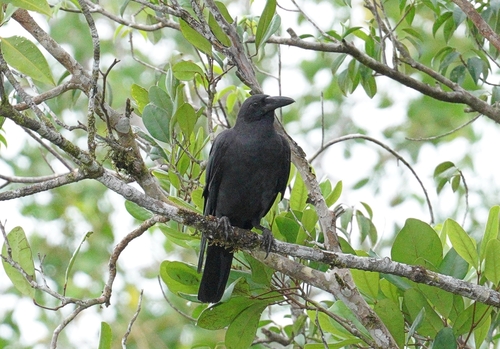
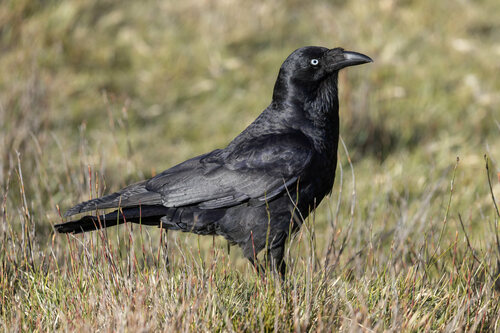
The forest raven, scientifically named Corvus tasmanicus Mathews, 1912, is the largest of Australia's corvids. Adult forest ravens measure 50–53 cm (20–21 in) in length, have a 91–113 cm (36–44 in) wingspan, and weigh approximately 650 g (1.43 lb). Its plumage has no seasonal variation: it is entirely glossy black, with a blue or green sheen that appears on the upperparts. The species has long, broad wings; when the bird is at rest, the largest of its ten primary feathers, usually the seventh and occasionally the eighth, almost reaches the end of the tail. The tail is either rounded or wedge-shaped; it is quite short in Tasmanian populations, but longer in populations from northern New South Wales. The forest raven's beak has a similar shape to that of the little raven, but it is more massive and heavy-set. Bristles cover the upper mandible, including the nares and nasal groove. The mouth, tongue, and the powerful legs and feet are all black. The tibia is fully feathered, and the tarsus is long. Males and females have identical plumage; males are generally larger, but there is considerable size overlap between individual birds of different sexes. The forest raven can be told apart from the two crow species found in Australia by the grey base of its feathers, while the crow species have white feather bases. On the feather, the boundary between the pale base and the black upper region is gradual in ravens, and sharply defined in crows. Feather bases are not typically visible when observing the birds in the field, but they can sometimes be seen on windy days when feathers are ruffled. Compared to the two Australian crow species, all three Australian raven species are more heavily built with a broader chest; the forest raven is the stockiest of all three. Using relative size to identify the species is only helpful when two species can be seen side by side, since size overlap is large and size differences between species are small. In Tasmania, the forest raven might be confused with the black currawong, but the black currawong has more slender wings with white markings, a longer tail, and a very different call. Juvenile forest ravens, birds up to one year old, have a shorter, shallower dark grey bill with some pink at the base, and a pink gape. Their plumage is softer and fluffier, often with a brown tint, and generally lacks the glossy sheen of adult plumage, though a blue-purple sheen can sometimes be seen on the mantle and shoulder feathers. Birds between one and two years old closely resemble adults, but still keep juvenile feathers on their wings and tail and have smaller bills. Birds between two and three years old have full adult plumage, but do not yet have adult eye colour. Eye colour changes with age: nestlings up to four months old have blue-grey eyes; juveniles aged four to fourteen months have brown eyes; immature birds have hazel eyes with blue eyerings around the pupil until they reach two years and ten months of age. The forest raven is the only corvid species with a permanent population in Tasmania, and it is the most widely distributed bird species in the state. There are three separate populations on mainland southern Victoria: one ranging from the Lakes Entrance area west across Gippsland to Wilsons Promontory; a second occupying the Otway Ranges from 10 km (6.2 mi) west of Torquay to Port Campbell; and a third found in the Grampians and Millicent Plain, which extends into south-eastern South Australia. Isolated observations suggest the last two of these populations may actually connect into a single continuous population. There are two disjunct populations in northern New South Wales. A coastal population occurs from Tea Gardens north to Yuraygir National Park, while a more montane population lives along the Great Dividing Range and New England Tableland from the Gloucester Tops in the south to Tenterfield in the north. The gap between the two populations is around 70 km (43 mi), narrowing to 30 km (19 mi) near Dorrigo. In Tasmania, the forest raven lives in a wide variety of habitats, including woods, open broken forest, mountains, coastal areas, farmland, and town and city fringes. A survey of Mount Wellington found it is one of the few bird species that remains in open and marshland habitat at higher elevations through winter. Additional research in Tasmania found that forest ravens are thirty percent more likely to be observed in farmland habitat than in non-agricultural forested or urban areas. On mainland Australia, the species appears to be more restricted to forests: wet and dry sclerophyll forest, cool temperate rainforest, and pine plantations in Victoria. Populations in Victoria and New South Wales are possibly expanding, and the species is increasingly seen in towns such as Forster-Tuncurry and Port Macquarie, and along sections of the Oxley Highway between Wauchope and Walcha, and Thunderbolts Way between Gloucester and Nowendoc. This is most likely due to increased roadkill availability from growing vehicular traffic. It is still unclear whether records of forest ravens in previously unrecorded areas since the 1970s are the result of range expansion or improved field observation and species identification. Forest ravens travel from Tasmania and the Australian mainland to offshore islands in Bass Strait, and may even cross the entire strait. They were first recorded on King Island in Bass Strait in 1979, and had become numerous enough that flocks of several hundred birds were recorded there by 1997. King Island was previously inhabited by little ravens.