About Corvus splendens Vieillot, 1817
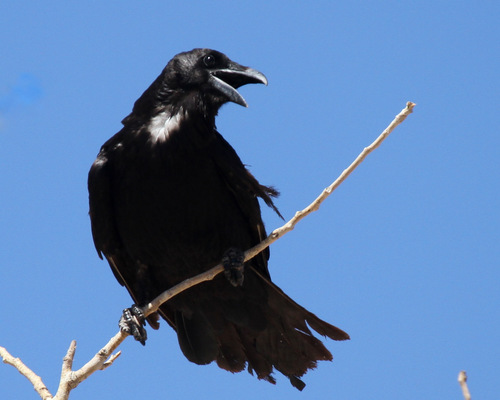
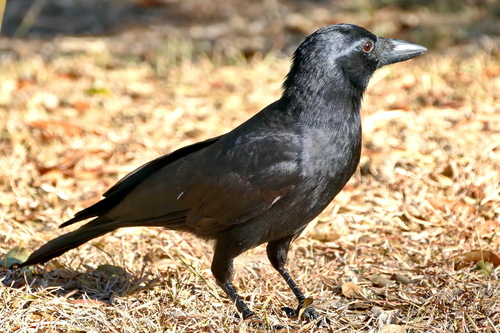
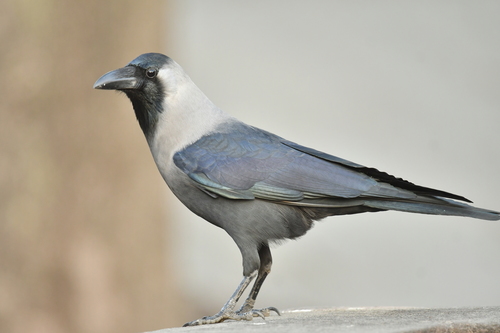
The house crow, scientific name Corvus splendens Vieillot, 1817, is also called the Indian crow, greynecked crow, Ceylon crow, or Colombo crow. It is a common member of the crow family that originated in Asia, and is now found in many parts of the world after being transported by shipping. It measures 40 cm (16 in) in length, falling between the jackdaw and carrion crow in size, but is slimmer than both of these species. Its forehead, crown, throat, and upper breast are richly glossy black, while its neck and lower breast are lighter grey-brown. The wings, tail, and legs are all black. Regional variations exist in how thick its bill is, and how deep the color of different plumage areas is. The house crow has a wide native distribution across southern Asia: it is native to Nepal, Bangladesh, India, Pakistan, Sri Lanka, the Maldives, the Laccadive Islands, southern Myanmar, south Thailand, and coastal southern Iran. It was introduced to East Africa around Zanzibar (around 1897) and Port Sudan. It arrived in Australia by ship, but has been completely exterminated there to date. It has more recently reached Europe, and has bred in the Dutch harbour town of Hook of Holland since 1998. A population of between 200 and 400 house crows lives in Sham Shui Po, New Kowloon, Hong Kong, particularly in Lai Kok Estate, Sham Shui Po Park, and Kowloon Tsai Park in Kowloon Tsai. One individual has been present in Cork Harbour on the south coast of Ireland since early September 2010. In the New World, a small population of house crows is established in the area around St. Petersburg, Florida. As of April 2009, the introduced house crow population on Socotra Island, Yemen, has been eradicated to prevent negative ecological impacts on Socotra's endemic species. Across its entire range, the house crow is closely associated with human settlements, ranging from small villages to large cities. In Singapore, a population density of 190 birds per square kilometer was recorded in 2001, and plans were underway to suppress the population at that time. This species has increased in population in proportion to the human population explosion in the areas it inhabits. As an omnivorous scavenger, it is well suited to thrive in human-altered environments.