About Corvus moneduloides Lesson, 1831
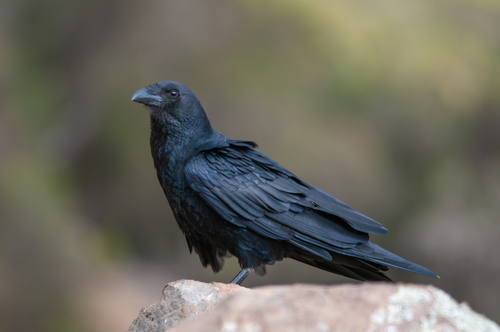
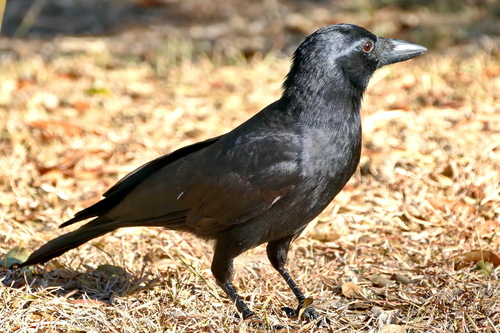
The New Caledonian crow, scientific name Corvus moneduloides Lesson, 1831, is a moderate-sized crow that measures 40 centimetres (16 in) in length. It is similar in size to the house crow, but has a less slender body shape. This crow has an all-black plumage that shows a rich gloss of purple, dark blue, and some green when seen in good light; its beak, feet, and legs are all black. The beak is moderate in size, with an unusual trait: the tip of the lower mandible angles upwards, giving it a somewhat chisel-like profile. It has been suggested that this beak shape evolved under selective pressure to help the species hold tools straight. Its vocalizations are described as a soft "waa-waa" or "wak-wak", and sometimes a hoarse "qua-qua" or "waaaark". Across New Caledonia, the species is commonly called 'qua-qua' after its distinctive call. This bird is endemic to the Pacific islands of New Caledonia, where it lives in primary forest. It only inhabits the main island Grande Terre and Maré Island, one of the Loyalty Islands. The New Caledonian crow eats a wide variety of foods, including many types of insects and other invertebrates (some caught in flight with great agility, including night-flying insects which it catches at dusk), eggs and nestlings, small mammals, snails (which it drops from a height onto hard stones), and various nuts and seeds. This species is well known for using plant material to create stick and leaf tools to capture prey hiding in cracks and crevices. These tools may have naturally occurring barbs, and are sometimes fashioned into hooks by the crows. The tool is inserted into a crack or crevice in a log or branch, which agitates the prey into biting the tool. The crow then pulls the tool out with prey still attached, and eats the prey. Grubs caught this way have been shown to be an integral part of the crows' diet. Since New Caledonia has no native woodpeckers, the New Caledonian crow fills the ecological niche occupied by woodpeckers elsewhere and by the woodpecker finch on the Galapagos. The woodpecker finch's feeding method differs: it stabs at grubs and slowly levers them out of logs using a small twig. The New Caledonian crow builds its nest high in a tree, and usually lays 2–3 eggs between September and November. In the wild, this species uses small twigs as stick tools, probing them into holes in logs to extract insects and larvae. New Caledonian crows can also manufacture functional stick tools by breaking twigs off bushes and trimming them to size. Tool manufacture is rare compared to simple tool use, and indicates a higher level of cognitive function. The crows also make leaf tools by tearing rectangular strips from the edges of Pandanus spp. leaves. Creating these leaf tools lets them use naturally occurring hooks: the barbs running along the leaf edges work as hooks when the tool is held so the barbs point toward the crow's head. The crows also incorporate other naturally occurring hooks, such as thorns from New Caledonian vine species, into their tools. They craft hooks from both wood and ferns by trimming the junctions between two branches or fern stolons into a T shape, then removing material from the junction to create a working hook. This shaping of three-dimensional form from natural material is similar to carving. The species has a specific method for crafting leaf tools: crows snip into leaf edges, then tear out neat strips of vegetation to use for probing crevices that hold insects. Three types of these leaf tools have been observed: narrow strips, wide strips, and multi-stepped strips. Multi-stepped strips are wide at one end, and become narrow at the opposite end through a stepwise process of snips and tears. The New Caledonian crow is the only non-primate species with documented evidence of cumulative cultural evolution in tool manufacture. This means the species appears to invent new tools by modifying existing ones, then pass these innovations to other individuals in its cultural group. Gavin R. Hunt and colleagues at the University of Auckland studied tools the crows make from pandanus (screw pine) leaves. Observations of the distribution of 5,500 leftover leaf counterparts or stencils from the cutting process suggest that narrow and stepped tools are more advanced modified versions of the wide tool type. The geographical distribution of each tool type across the island suggests each type had a single unique origin, rather than multiple independent inventions. This implies that the delicate manufacturing process innovations are passed from one individual to another. New Caledonian crows also spontaneously make tools from materials they do not encounter in the wild. In 2002, researcher Alex Kacelnik and colleagues at the University of Oxford observed two New Caledonian crows named Betty and Abel in an experiment where the birds had to choose between a hooked and a straight wire to retrieve small pieces of their favorite food, pig heart. When Abel took the hooked wire, Betty bent the straight wire into a hook and used the tool to lift a small bucket of food from a vertical pipe. This was the first time the crows had been presented with wire. This initial observation led to further investigation in a series of studies. Out of ten successful food retrievals, Betty bent the wire into a hook nine times, and Abel retrieved the food once without bending the wire. The process usually started with Betty attempting to retrieve the food bucket with the straight wire, then bending it into a hook (most often by snagging one end of the wire under an object) before using the bent hook to lift the tray. Betty's hook creation cannot be explained by shaping or reinforcement from trial-and-error behavior. In 2004, Hunt observed wild New Caledonian crows making hooks naturally, but adapting the novel material of wire for tool use was clearly a new, purposeful behavior. Intentional tool manufacture, even when it involves extending prior experience to a new context, is rare in the animal kingdom. These crows also use tools to investigate potentially dangerous objects, such as a rubber snake or a flashing LED bike light. New Caledonian crows have demonstrated the ability to process information from mirrors, a cognitive ability only a small number of species have. Wild-caught New Caledonian crows can use mirrors to find objects they cannot see via direct line of sight. However, the crows were not able to recognize themselves in the mirror, a capability other corvids have tested positive for.