About Corvus coronoides Vigors & Horsfield, 1827
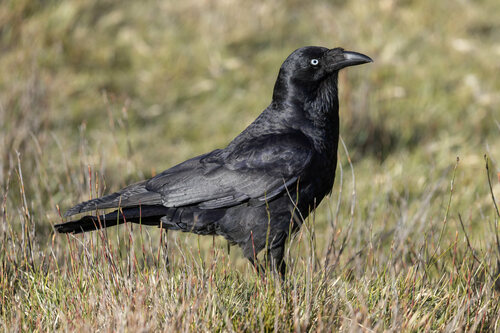
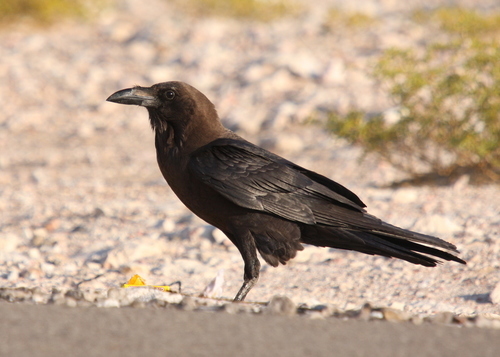
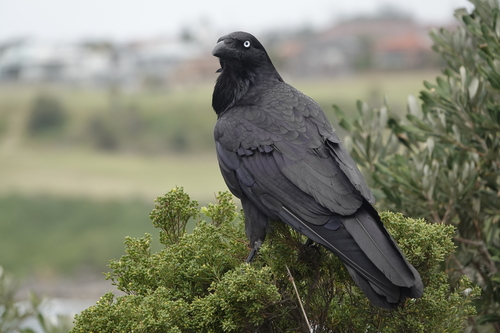
Measuring 46–53 cm (18–21 in) in length, with a 100 cm (39 in) wingspan and an average weight of around 650 g (1+7⁄16 lb), the Australian raven (Corvus coronoides) is Australia's largest corvid species. Adult Australian ravens are entirely black, with a black beak, black mouth, black tongue, and sturdy black or grey-black legs and feet. The tibia is fully feathered, the tarsus is long, and the feet are large and strong. Adults have white irises. Their plumage is glossy, with a blue-purple to blue-green sheen that appears greenish over the ear coverts, depending on light conditions; the underparts are not glossy. This species has lanceolate throat feathers called hackles with rounded tips, unlike the other four Australian corvid species, which have hackles with bifurcate tips, a feature that can be difficult to see in the field. The Australian raven's hackles are also longer than those of the other four species; when the hackles are raised, such as when the bird is calling, they create a distinct bearded appearance. The upper third of the upper mandible, including the nares and nasal groove, is covered with bristles that can reach up to 3 cm (1+1⁄4 in) in length. The heavy beak is tipped with a slight hook, and is longer than the bird's head. The wings are long and broad; when the bird is at rest, the longest of its ten primary feathers, most often the seventh but occasionally the eighth, almost reaches the end of the tail. The tail is rounded or wedge-shaped. The Australian raven can be told apart from the two crow species native to Australia by the grey base of its feathers; these bases are white in Australian crows. The boundary between the pale base and black portion of each feather is gradual in Australian ravens, and sharply defined in Australian crows. Feather bases are not usually visible when observing birds in the field, but they can sometimes be seen on windy days when the bird's feathers are ruffled. Unlike the other four Australian corvid species, the Australian raven has a bare patch of skin under and extending to the side of its bill, though this feature can also be hard to make out in the field. The three Australian raven species have a heavier build and a broader chest than the two Australian crow species; the forest raven is the stockiest of all these corvids. Comparing relative size is only helpful when two species can be seen side by side, as there is large overlap in size and the size difference between species is small. Juvenile Australian ravens resemble adults, but do not have developed throat hackles, and sometimes have a pink fleshy gape. The juvenile bill is shorter and shallower; its base may be pinkish and its tip may be light grey. Juvenile plumage is more ruffled and softer in appearance, lacks glossy highlights, and often has a brown tinge. The bare throat skin is pink in birds that have recently left the nest. Eye colour changes with age, gradually lightening as the bird matures from juvenile to adult. Nestlings up to four months old have blue-grey irises, juveniles four to fifteen months old have dark brown irises, and immature birds have hazel irises with an inner blue rim around each pupil until they reach two years and ten months of age. Immature birds older than one year develop hackles, and some pink may remain in the gape until the bird is two or three years of age. The Australian raven is common across eastern Australia and southern Western Australia, with these two populations connected by a narrow strip of habitat across the Nullarbor Plain. It is rarer and more scattered in the north, with isolated sightings recorded at Coen, Windmill Creek, and the Mitchell River on Cape York, and becomes more common south of Rockhampton in central Queensland. It is found throughout New South Wales, though it is uncommon in the northeast of the state. It is rare in the Australian Alps, where it is replaced by the little raven. It occurs across Victoria and eastern South Australia, through the Eyre Peninsula and Nullarbor Plain into Western Australia, extending north across the state to the Wooramel River. It can also be found on some offshore islands including Rottnest Island and Kangaroo Island, and is a rare vagrant to Lord Howe Island. This raven occupies a wide range of both natural and human-modified habitats. It requires access to water and trees (or buildings) to roost or perch on. Its preferred habitats are eucalypt-dominated sclerophyll forest, and farmland located adjacent to trees. It is also found in heath and mangroves. In areas where it occurs alongside the little raven, across most of central New South Wales, Victoria, and into South Australia, the Australian raven is restricted to more forested areas, while the little raven prefers more open areas. In inland Australia, it can share its range with the little crow, and the two species do not appear to compete. However, the ranges of the similarly sized forest raven and Torresian crow only narrowly overlap with the Australian raven, as all three species compete with one another. In central and western regions, Australian ravens and Torresian crows compete for scattered uncommon trees and outcrops, so only one of the two species is found in any given local area. It co-occurs with the forest raven in northeastern New South Wales, from Port Stephens northwards. The Australian raven has adapted very well to human habitation in some Australian cities, and is the most common corvid in Canberra, Sydney, and Perth; it is replaced by the little raven in Melbourne and Adelaide, and by the Torresian crow in Brisbane. Because of its large range, abundance, and increasing population, the Australian raven is classified as Least Concern on the IUCN Red List.