About Corvus cornix Linnaeus, 1758
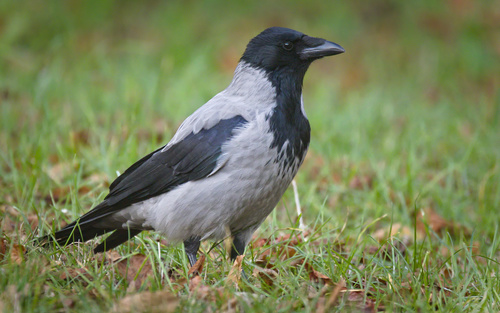
The hooded crow, Corvus cornix Linnaeus, 1758, has ash-grey plumage across most of its body; the head, throat, wings, tail, and thigh feathers are black and mostly glossy. Dark shafts on the grey feathers create a streaky appearance. The bill and legs are black, and the iris is dark brown. Like other crow species, the hooded crow only molts once per year, in autumn. Males are typically larger than females, but the two sexes look similar otherwise. The hooded crow's flight is slow, heavy, and usually straight. Adult body length ranges from 48 to 52 cm (19 to 20 in), average wingspan is 105 cm (41 in), and average body weight is 510 g. Newly hatched young are much blacker than adult hooded crows. Juveniles have duller plumage, bluish or greyish eyes, and have a red mouth when young. The contrasting grey and black plumage of the hooded crow makes it visually distinct from both the carrion crow and the rook. However, the calls of the hooded crow and carrion crow are almost indistinguishable. The hooded crow breeds in northern and eastern Europe, and closely related forms live in southern Europe and western Asia. Where the hooded crow's range overlaps with the carrion crow's range, including in northern Britain, Germany, Denmark, northern Italy, and Siberia, the two species produce fertile hybrids. These hybrids are less well-adapted than purebred birds, so the overlapping hybrid zone between the two species remains consistently narrow. This hybrid zone pattern was one of the main reasons the hooded crow was reclassified as a separate distinct species from the carrion crow. In the British Isles, the hooded crow breeds regularly in northern and western Scotland, the Isle of Man, the Scottish Islands, and across all of Ireland. Each autumn, some migratory hooded crows arrive on the east coast of Britain. Historically, the hooded crow was a more common visitor to this area.