About Corvinella corvina (Shaw, 1809)
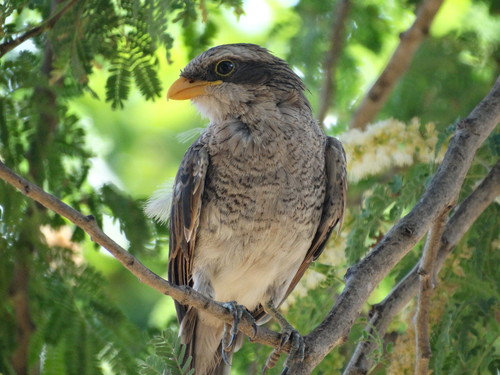
The yellow-billed shrike, with the scientific name Corvinella corvina (Shaw, 1809), measures 32 cm (13 in) long, and has a long, graduated tail and short wings. Adult individuals have mottled brown upperparts and streaked buff underparts, a brown eye mask, a rufous wing patch, and a yellow bill. The sexes are largely similar in appearance, but females have maroon patches on the flanks, while males have rufous patches. These patches are only visible when the bird is in flight, displaying, engaging in territorial disputes, or preening. Immature birds have buff fringes on their wing feathers. The legs and feet are black, and the beak is yellow even in juvenile birds. This species is a noisy bird, with harsh swee-swee and dreee-too calls. The yellow-billed shrike is resident in tropical Africa, south of the Sahara and north of the equator, and it is not present in the Horn of Africa. It occurs in Benin, Burkina Faso, Cameroon, the Central African Republic, Chad, Congo, the Democratic Republic of Congo, Côte d'Ivoire, Gambia, Ghana, Guinea, Guinea-Bissau, Kenya, Mali, Mauritania, Niger, Nigeria, Senegal, Sierra Leone, South Sudan, Sudan, Togo, and Uganda. It makes localised movements, though these movements have been little studied. This is a conspicuous, gregarious bird and a cooperative breeder, always seen in groups, often lined up on telephone wires. It builds a cup-shaped nest in a bush or tree, where four or five eggs are laid. Only one female in a group breeds at a given time, while other group members provide protection and food to the breeding pair. The yellow-billed shrike feeds on insects, which it locates from prominent lookout perches in trees, on wires, or on posts. They also sometimes eat small frogs, reptiles, and mice, but there is no record of them eating other birds or forming food larders.