About Cortinarius traganus (Fr.) Fr.
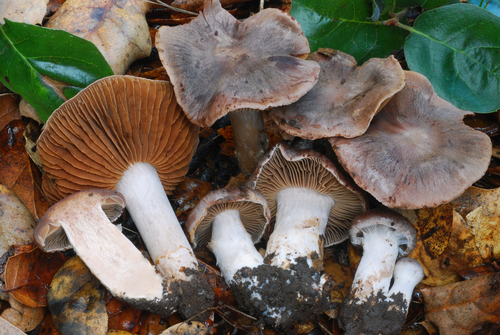
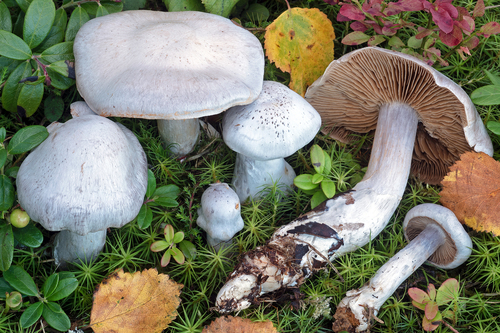
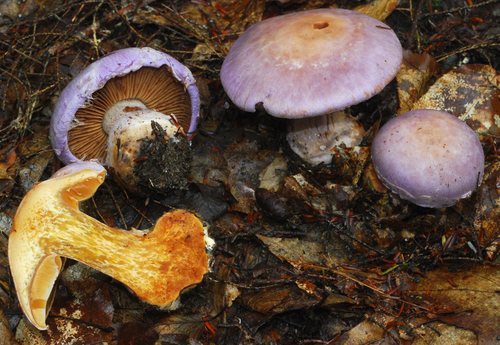
The cap of Cortinarius traganus measures 4–13 centimetres (1+1⁄2–5 in) in diameter. It starts out spherical to convex with an inward-rolled margin, then becomes flattened, sometimes developing a large, broad central umbo. The cap margin often cracks in a star-like pattern, especially during dry weather. The mushroom is pale azure violet to pale lilac when young, and quickly bleaches and fades to tan brown or rusty brown. The cap surface is dry, silkily shiny or tomentose at the margin, with membranaceous bronze fragments of the veil; white veil fragments often stick to the surface like scabs. As the mushroom matures, the cap surface cracks into small scales. The gills are sub-crowded, quite thick, broadly adnate, and often slightly notched (emarginate). They are 7–15 mm (1⁄4–5⁄8 in) broad; they are slightly dirty violet when young but usually brown with only a faint violet tint, becoming fully brown later, and are dusted saffron ochre with a lighter crenulate edge. The stem is 5–12 cm (2–4+3⁄4 in) long and 1–4 cm (3⁄8–1+5⁄8 in) thick, tough, thick, bulbous at the base, and spongily stuffed inside. The upper part of the stem above the cortina stays vivid violet for a long time, while the lower part is paler. The stem is covered with a tough, whitish, boot-like veil that usually leaves upright zones on the stem. The cortina itself is violet. The flesh is saffron yellowish-brown to yellowish-brown from the start, except it is dirty violaceous at the tip of the stem. The mushroom has an unpleasant goat-like odor that is strong enough to induce vomiting in more sensitive individuals. It has a strong, bitter taste, particularly when young, and is also described as having a somewhat fruity smell. The spore-bearing basidia measure 30–35 by 6.5–7.5 μm. The spore deposit is rusty brown. The spores are ellipsoid, covered with fine warts or dots, and measure 8–9 by 5–5.5 μm. Cortinarius traganus grows in coniferous forests worldwide. It prefers poorer, both siliceous and non-calcareous, soils. It is widespread across the temperate zone of the Northern Hemisphere, and is fairly common in North America. It generally fruits from August to September, and fruits somewhat later on the West Coast of North America.