About Cortinarius kioloensis A.E.Wood
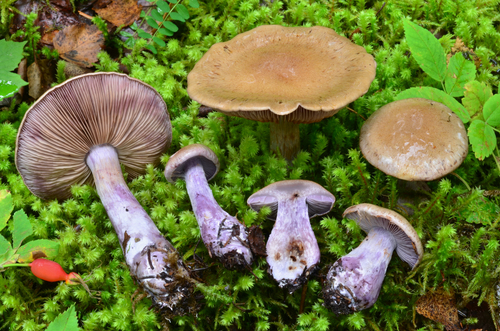
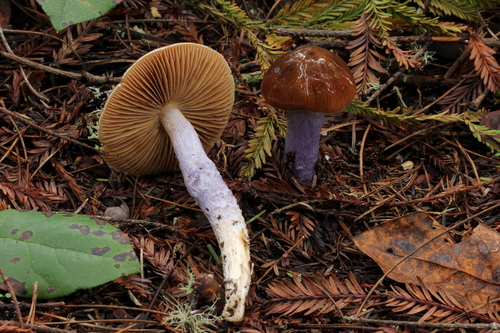
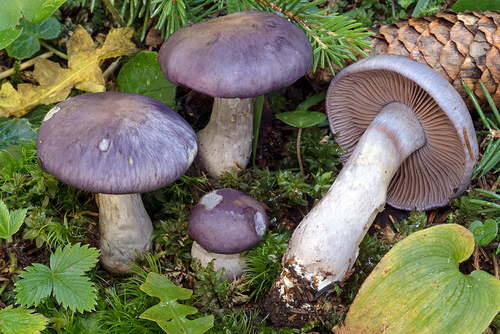
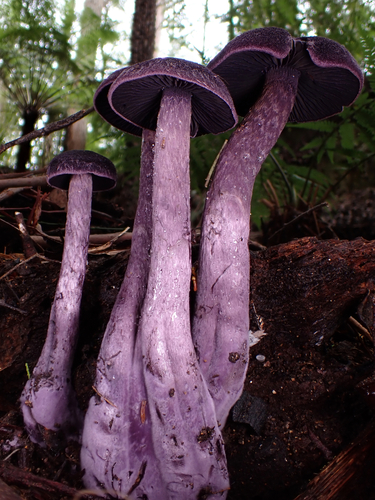
The fungal species Cortinarius kioloensis A.E.Wood produces fruit bodies with dark violet convex caps measuring 4.5–12 cm (1+3⁄4–4+3⁄4 in) wide; as caps mature, they become flattish with a low, wide boss. The cap surface is dry, covered in fine scales or hair. Its outer cap layer, called the pileipellis, is classified as a trichoderm: it is made of parallel hyphae that grow perpendicular to the cap surface, forming a layer 8–20 μm wide. Cap color is paler toward the entire margin, which may split or become wavy in older specimens. The mushroom's flesh is dark purple to black, and all parts of the mushroom stain red when treated with potassium hydroxide. The gills are thick, wide, dark blue, and sinuate. The stipe is pale violet, measuring 10.5–16.5 cm (4+1⁄4–6+1⁄2 in) high; it is 0.7–2.8 cm (1⁄4–1 in) wide at the top, and 0.9–3.1 cm (1⁄4–1+1⁄4 in) wide at its bulbous base. The stipe turns dark blue when handled or touched, due to its violet universal veil. The mycelium of Cortinarius kioloensis is pale violet. Its spores are oval, very warty, and measure 10.5–14 μm long by 6.5–9 μm wide. This mushroom has no strong aroma. Geographic distribution and habitat differences separate it from similar species. The otherwise identical Cortinarius atroviolaceus grows in montane rainforest in Malaysia. Cortinarius atrolazulinus and Cortinarius carneipallidus grow with Nothofagaceae in New Zealand. Cortinarius jenolanensis has a smooth cap, while Cortinarius austroviolaceus has less warty spores. Fruit bodies of Cortinarius kioloensis grow in autumn and winter, from April to July. They are found under Eucalyptus and Allocasuarina in southeastern Australia and Tasmania, and in association with Leptospermum in New Zealand. In the Australian state of New South Wales, collections have been made along Gore Creek in Lane Cove Bushland Park, on Couranga Track in Royal National Park, at Boronia Park, Bradleys Head, and Scotland Island, and at Hazelbrook and Sassafras Gully near Springwood in the Blue Mountains.