About Cortinarius iodes Berk. & M.A.Curtis, 1853
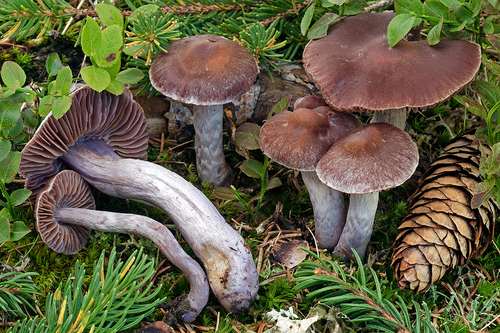
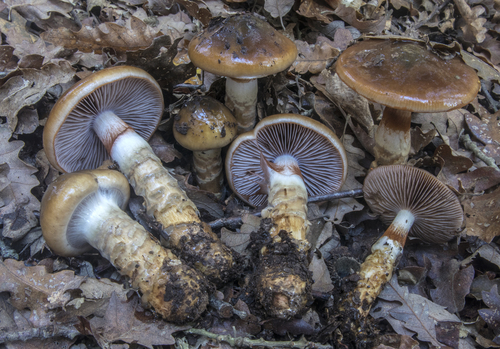
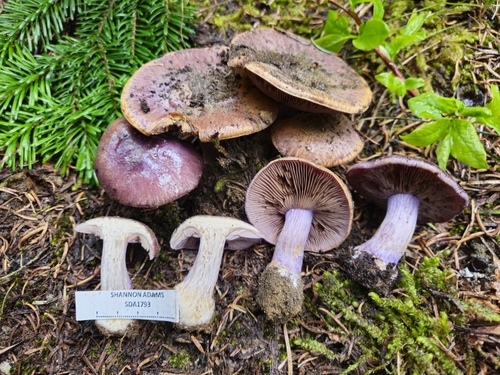
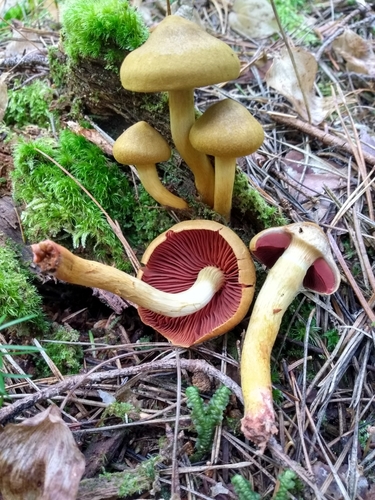
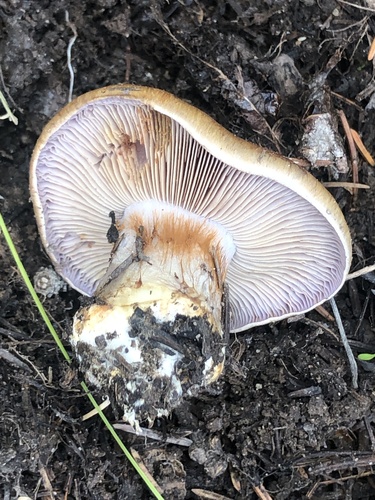
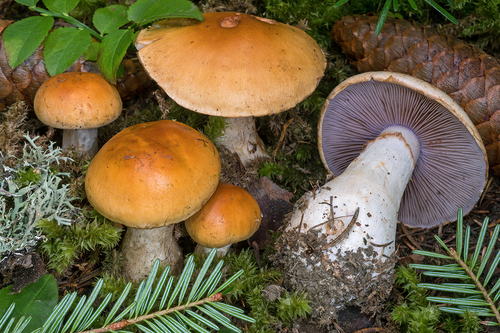
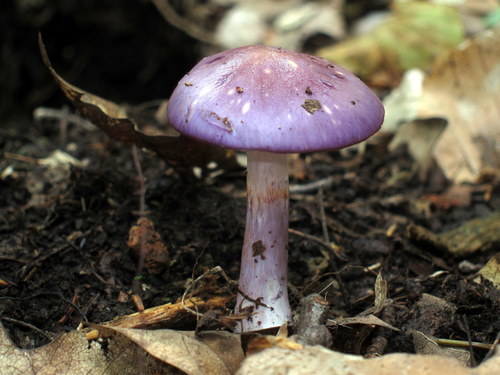
The cap of Cortinarius iodes starts out bell-shaped, becomes broadly convex, and eventually flattens at maturity, sometimes keeping a broad umbo. It reaches a diameter of 2–6 cm (3⁄4–2+1⁄4 in). The cap surface is smooth and slimy in wet weather, and is lilac or purplish when young; its color fades as it matures, and the cap develops irregular yellowish spots, or turns yellowish in the center. The flesh is white, firm, and thin. The gills attach to the stem and are packed closely together. They are lilac to violet when young, turning rusty brown to grayish cinnamon as spores mature. The stem is 4–7 cm (1+1⁄2–2+3⁄4 in) long and 0.5–1.5 cm (1⁄4–1⁄2 in) thick, is roughly equal in width along its length and has a somewhat bulbous base. It is solid (not hollow), slimy, and smooth, and is violet or purplish, usually in a lighter shade than the cap; the stem base is sometimes more or less white. The cobweb-like pale violet partial veil leaves a zone of thin purple or rusty fibers on the upper stem. The mushroom has no distinctive taste or odor, and is not recommended for consumption. Cortinarius iodes produces a rusty-brown spore print. Its spores are elliptical with a finely roughened surface, and measure 8–10 by 5–6.5 μm. The spore-bearing cells (basidia) are four-spored, club-shaped, and measure 28–39.5 by 9.3–14 μm. Neither cheilocystidia nor pleurocystidia are present in the hymenium; the gill edge is made up of basidia and their undeveloped equivalents, basidioles. The cap cuticle is made of a distinctive layer of 3–8 μm-wide hyphae that forms a layer usually 110–125 μm thick; this layer is thinner or less distinct in old or poorly preserved specimens. Clamp connections are present in the hyphae throughout the entire fruit body. Cortinarius iodes forms mycorrhizal associations with deciduous trees, especially oaks. Its fruit bodies sometimes grow singly, but more often grow scattered or in groups under hardwood trees, in humus and leaf litter. Typical habitats include bog edges, swampy areas, and hummocks. Fruiting usually occurs between July and November. In North America, it is common in eastern regions and rare in the Pacific Northwest. Its distribution ranges from eastern Canada south into Central America and northern South America, and it also occurs in northern Asia. More recently, it has been found in Serbia, Europe.