About Cortinarius camphoratus (Fr.) Fr.
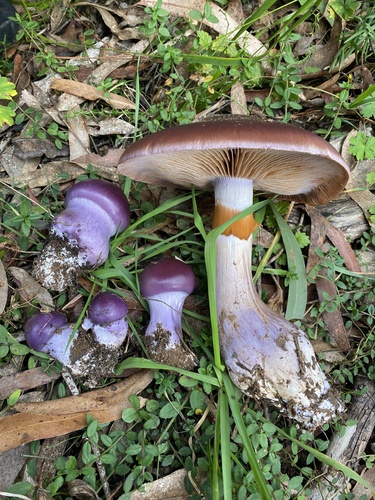
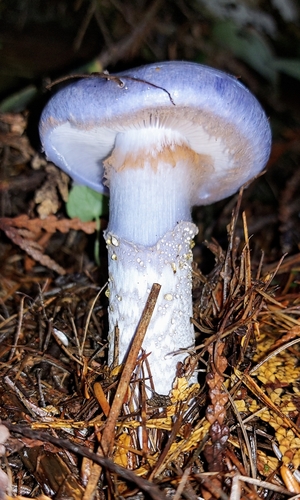
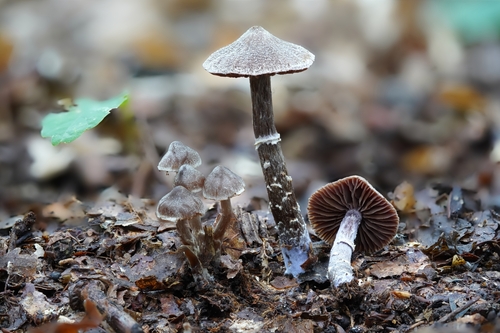
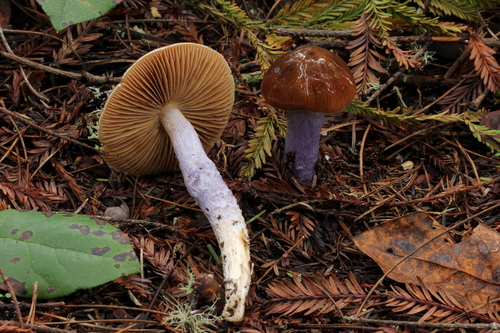
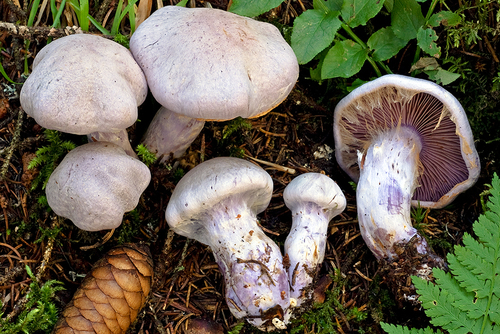
The fruit bodies of Cortinarius camphoratus have caps that start out convex before flattening, and some develop a broad umbo. Cap diameters range from 4 to 10 cm (1.6 to 3.9 in). The cap margin is initially curled inwards, and uncurls as the mushroom matures. The cap surface is covered with minute matted fibers, and is buff with lilac tints; golden tones typically develop as the mushroom ages. The lilac to purple flesh has no distinctive taste, and an odor that has been compared to curry powder, rotting meat, old goats or goat's cheese, cold mashed potato, burnt horn, or sweaty feet. The gills attach to the stipe in an adnate arrangement; they are pale lilac when young, turning rusty-brown as spores mature. The stipe is 5 to 10 cm (2.0 to 3.9 in) long by 1 to 2 cm (0.4 to 0.8 in) wide, and thickens toward its base. It is roughly the same color as the cap, solid (not hollow), and covered with silky white matted fibrils up to the annular zone. This annular zone forms when the cobwebby white partial veil collapses onto the stipe. There is widespread disagreement about the edibility of Cortinarius camphoratus: it has been called edible, inedible, and somewhat poisonous. It is generally not recommended for consumption. This species produces a rusty-brown spore print. Its spores are pale brown, elliptical to slightly almond-shaped, with minute, well-separated warts on the surface, and measure 8.5–11 by 5.5–6.5 μm. The cap cuticle is a cutis, made up of hyphae that run parallel to the cap surface; these hyphae measure 3–8 μm wide. Cortinarius camphoratus is found in Europe and North America, where it grows as a mycorrhizal associate of conifers, including firs, and especially spruce. Mushrooms grow on the ground, appearing singly, scattered, or in groups, most often between September and October.