About Cortinarius archeri Berk.
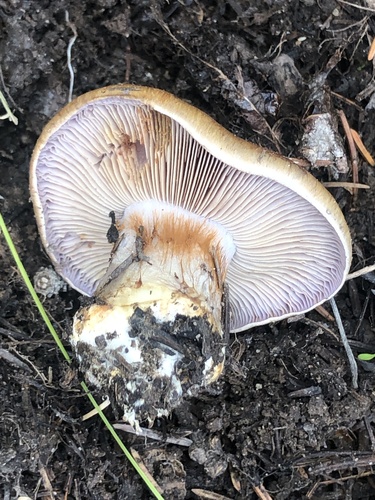
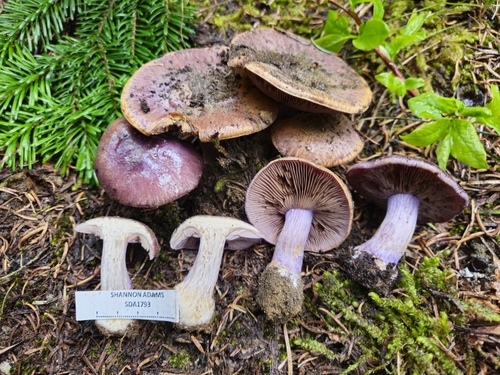
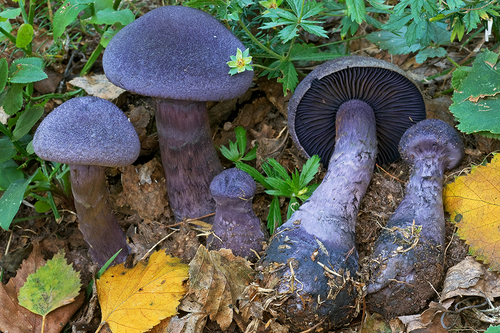
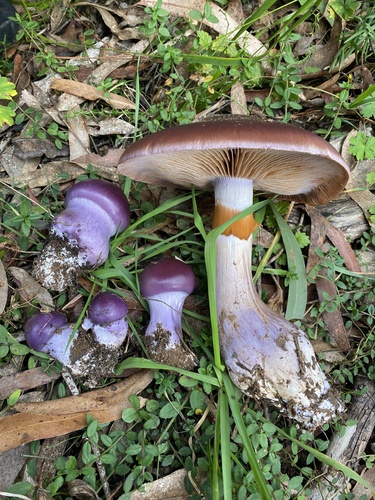
Cortinarius archeri Berk. has a cap that grows up to 10 cm (4 in) across. Young caps are convex with strongly incurved margins, and flatten as the mushroom ages. A central raised boss may be present at the cap's centre. Young caps are deep violet in colour, fading to violet-brown with age; they are smooth and glutinous. The thick flesh is tinted lavender. The gills are brown with a lilac-violet tint. The stipe is 6 to 8 cm (2.4 to 3.1 in) long, cylindrical, and often swollen at the base. It is pale lilac in colour above the cortina, and deep violet below it. Spores are brown, and mature fruit bodies produce a brown spore print. The species has no noticeable odor, and has a mild taste. Young C. archeri specimens have a flimsy cortina, which tears apart as the cap expands. As a result, few fully mature specimens retain any trace of the cortina. This is one of the most common webcap species found in southern Australia. Its distribution ranges across Queensland, South Australia, and Western Australia. Around Sydney, it has been recorded in Oatley, Howes Valley, Tari Creek in Windsor, and Boronia Park, and it is regularly seen in Lane Cove National Park, particularly around North Ryde. In Victoria, it occurs in Morwell National Park, and it was the only Cortinarius species recorded during the Field Naturalists Club of Victoria's first fungi foray at Coranderrk Bush Sanctuary. In South Australia, it is found in the Mount Lofty Ranges east of Adelaide. In Western Australia, it has been recorded at Mundaring. In Tasmania, it has been found in wet forests, dry forests, and cleared areas, including Mount Wellington, Mount Field National Park, and Bruny Island. The species was also recorded during the 15th New Zealand Fungal Foray and is held at the New Zealand Fungal Herbarium. C. archeri is mycorrhizal, forming close associations with the roots of eucalyptus or closely related trees, and is common in eucalypt forests or mixed forests. Though described as solitary, it is often found in small groups of two or three, typically growing up through bark and leaf litter on the forest floor. It can grow well in recently burnt forests, and is also sometimes found growing in suburban lawns.