About Correa glabra Lindl.
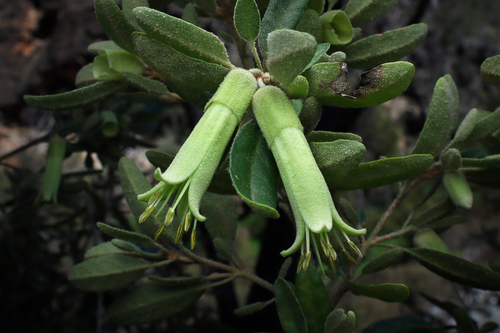
Correa glabra Lindl. is an erect shrub that typically grows to a height of 2.7 meters (8 feet 10 inches). Its leaves are elliptical, or sometimes egg-shaped with the narrower end toward the base. They range from papery to leathery in texture, are 10–40 mm (0.39–1.57 in) long and 5–17 mm (0.20–0.67 in) wide, and release a strong, sweet lemon scent when crushed. The flowers are pendent, and usually arranged singly on short side shoots, borne on a pedicel 2–4 mm (0.079–0.157 in) long, with linear to lance-shaped bracteoles 4–7 mm (0.16–0.28 in) long. The calyx is 3–10 mm (0.12–0.39 in) long, while the corolla is pale green to pale yellow, cylindrical to funnel-shaped, and 15–40 mm (0.59–1.57 in) long. The eight stamens extend well beyond the end of the corolla. Flowering occurs sporadically throughout the year, but mainly takes place in autumn and winter. This species, commonly called rock correa, is distributed across south-eastern Queensland, New South Wales, western Victoria, and extends west to the Fleurieu Peninsula in South Australia. Variety glabra occurs in south-eastern Queensland, New South Wales, and central and western Victoria, where it mainly grows in rocky habitats near watercourses. Variety leucoclada, commonly known as white-stemmed smooth correa, grows in hilly locations along stream banks in the southern Mount Lofty Ranges and in central and eastern New South Wales; it is rare in South Australia but common in New South Wales. Variety turnbullii, commonly known as Turnbull's smooth correa, grows in the rocky hills of the Mount Lofty and Flinders Ranges, the Murraylands, and part of south-eastern South Australia. In horticulture, Correa glabra can be used as a low screening shrub or a container plant, and attracts birds to gardens. It will grow in a range of soil types, in both full sun and partially shaded positions, and can withstand frost. Pinching back new growth can keep the plant maintained in a compact shape. A number of cultivars have been documented. These include: Correa glabra var. glabra 'Coliban River', a compact, dense form selected from a wild population near the Coliban River in Kyneton, Victoria that grows to 1.2 metres in both height and width; C. glabra 'Apricot'; C. glabra var. turnbullii 'Barossa Gold'; C. glabra 'Gold Leaf'; C. glabra var. turnbullii 'Ian Fardon'; C. glabra var. glabra 'Inglewood Gold', a gold-flowered form selected from a wild population near Inglewood, Victoria around 1980; C. glabra 'Studley Park'; and C. glabra var. leucoclada 'Tambar Springs'.