About Correa decumbens F.Muell.
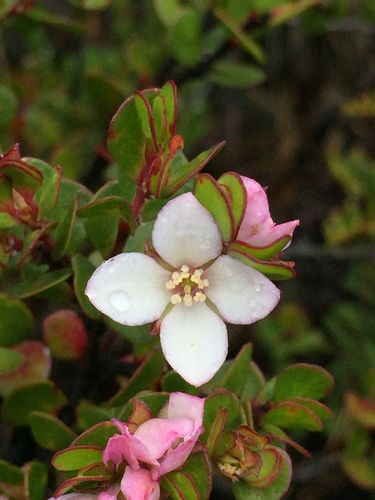
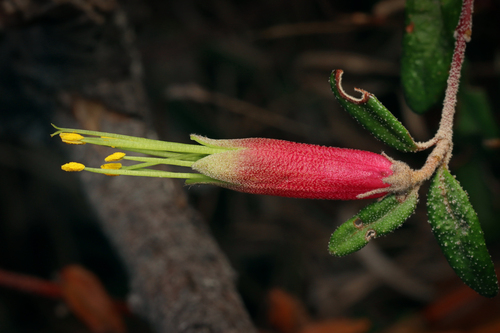
Correa decumbens is a prostrate to spreading shrub that typically grows to a height of 1 metre (3 feet 3 inches). Its branchlets are covered with reddish-brown hairs. The leaves are narrow oblong to narrow elliptical, usually 20–50 mm (0.79–1.97 in) long and 5–10 mm (0.20–0.39 in) wide, borne on a petiole 3–5 mm (0.12–0.20 in) long. The upper leaf surface is glabrous, while the lower leaf surface is covered in woolly, rust-coloured hairs. Flowers are usually arranged singly on the ends of short side shoots, on pedicels 5–10 mm (0.20–0.39 in) long, with linear to spatula-shaped bracts 5–10 mm (0.20–0.39 in) long at the base. The calyx is hemispherical to cup-shaped, 2–4 mm (0.079–0.157 in) long, covered in hairs, and has eight linear lobes 3–7 mm (0.12–0.28 in) long. The corolla is narrow cylindrical, pink to red with four green lobes, and 18–27 mm (0.71–1.06 in) long. The eight stamens extend well past the end of the corolla. In this species' native range, flowering occurs from November to February and also from April to August. This species, commonly called spreading correa, occurs in the southern Mount Lofty Ranges, where it grows in stringybark-dominated forest, and on Kangaroo Island, where it grows in forest dominated by sugar gum (Eucalyptus cladocalyx).