About Correa alba Andr.
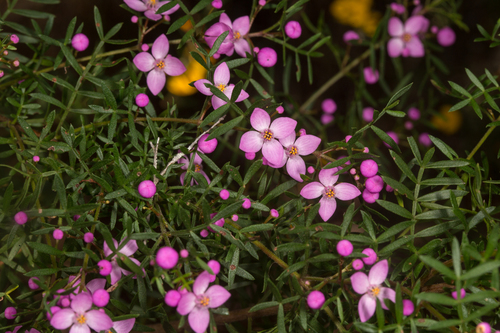
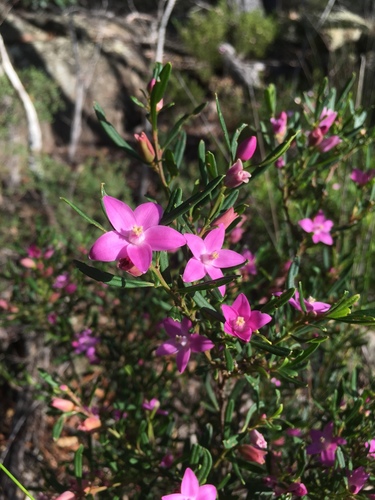
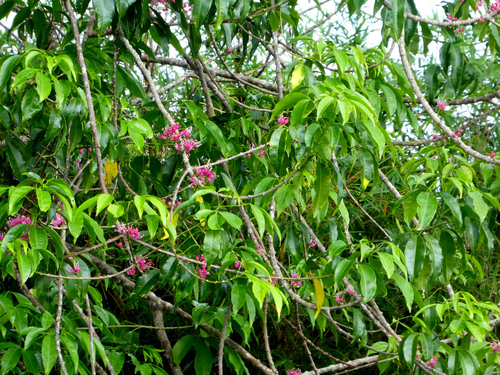
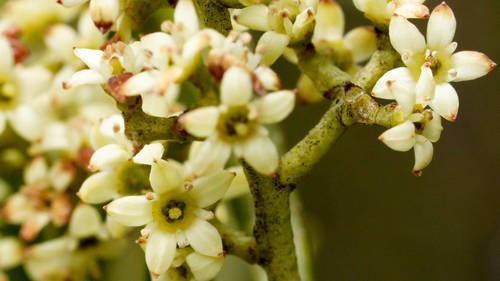
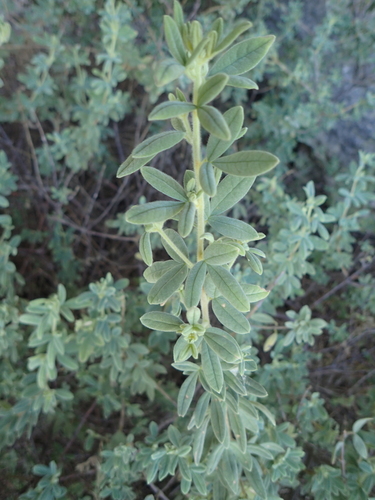
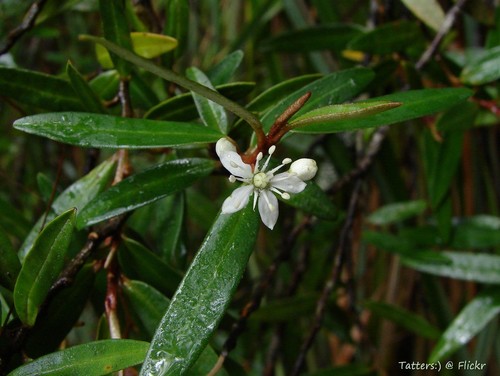
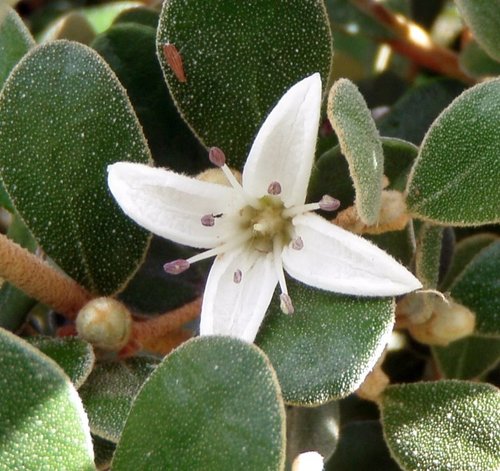
Correa alba Andr. is a prostrate to spreading shrub that typically reaches a height of 1.5 m (4 ft 11 in), with rust-coloured, woolly-hairy young stems. Its leaves are leathery, ranging in shape from elliptic to more or less round, 8–35 mm (0.31–1.38 in) long and 6–25 mm (0.24–0.98 in) wide, attached to a 0.5–1.5 mm (0.020–0.059 in) long petiole. The underside of the leaves is densely covered in woolly hairs. Flowers are arranged singly or in groups of up to five on the ends of short side branches, on pedicels 0.5–5 mm (0.020–0.197 in) long. The calyx is cup-shaped or hemispherical, 2–4 mm (0.079–0.157 in) long, and has four lobes. The petals are white, very rarely pale pink, 11–13 mm (0.43–0.51 in) long, woolly hairy on the back and spread more or less free from one another. The eight stamens are shorter than the petals. Flowering occurs mainly from April to June, and the fruit is 5–7 mm (0.20–0.28 in) long and green. This species, known as white correa, occurs in South Australia, New South Wales, Victoria and Tasmania. In New South Wales, it grows in sandy and rocky areas in near-coastal regions south from Port Stephens. In Victoria it is common in coastal heath and woodland, and its range extends to the far south east of South Australia. In Tasmania it is common on exposed rocky and sandy areas on the north and east coasts. Varietiy alba occurs from Port Stephens along the coasts of New South Wales as far west as Cape Otway in Victoria, and is also the variety found in Tasmania. Variety pannosa is found along the south-west coast of Victoria and extends as far east as the Encounter Bay region of South Australia. Ecologically, wombats have been recorded eating the leaves and roots of this plant. The 1889 book *The Useful Native Plants of Australia* records that this plant is commonly called "Cape Barren Tea" in Tasmania, and that sealers on islands in Bass's Straits used its leaves as a substitute for tea.