About Coronula diadema (Linnaeus, 1767)
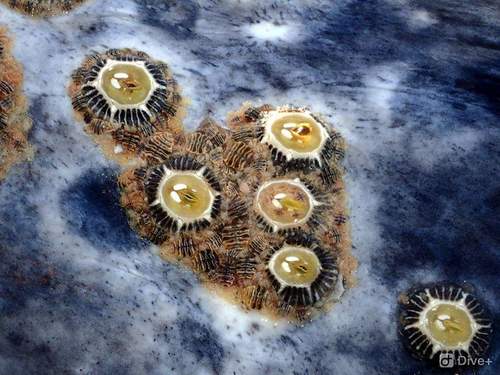
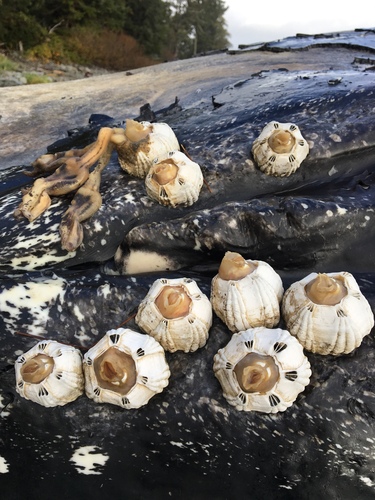
Coronula diadema (Linnaeus, 1767) resembles a crown in appearance as its name suggests, but becomes more cylindrical as it grows. Large specimens can reach 5 cm (2 in) in height and 6 cm (2.4 in) in diameter. Six broad wall plates surround a hexagonal orifice at the top of the barnacle, and this orifice is protected by a pair of opercular valves. The plates bear fine longitudinal striations, and their lower half often has irregular transverse striations. This species is found living on the external surface of whales. Zoologist Charles Darwin, who dedicated much of his career to studying barnacles, stated he knew the precise locations where four specimens had been found: the arctic seas around Scandinavia, the east coast of North America, waters near the coast of the British Isles, and the Gulf Stream. New Zealand was reported as another location for C. diadema, but Darwin suspected this report was an error, and the recorded specimen was likely Coronula reginae instead. The majority of hosts for C. diadema are baleen whales, particularly humpback whales (Megaptera novaengliae). The barnacles attach to the head, flukes, flippers, various grooves and genital slit of their host whales. C. diadema has also been found on blue whales (Balaenoptera musculus), southern right whales (Eubalaena australis), fin whales (Balaenoptera physalus), sperm whales (Physeter macrocephalus), and northern bottlenose whales (Hyperoodon ampullatus). For information on the proposed role of C. diadema on humpback whales’ pectoral fins in helping defend humpback calves from killer whales, see the Fins section of the Humpback whale entry. Like most barnacles, C. diadema are hermaphrodites that can fertilize one another but cannot self-fertilize, so they must grow in close clusters to breed. An individual acting as a male extends its long penis to impregnate the mantle cavity of another nearby individual. Internal fertilization occurs at this site, and embryos are brooded until their first moult. The resulting free-swimming nauplius larvae become part of the plankton community, and pass through six moults before developing into non-feeding cyprid larvae. Results from laboratory experiments indicate that cyprid larvae are triggered to settle and undergo metamorphosis into juvenile barnacles by chemical cues from the skin of suitable host whales.