About Coronidium monticola N.G.Walsh
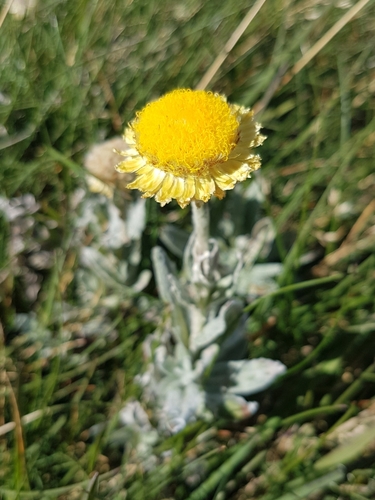
Coronidium monticola N.G.Walsh is an ascending to upright perennial herb, reaching around 35 cm (14 inches) in height. It often produces multiple branches from its base, and occasionally grows with a single stem. Its leaves are grey-green, ranging from egg-shaped to oblong lance-shaped, and are sessile (attached directly to the stem without a stalk). Leaves measure 20–50 mm (0.79–1.97 in) long and 3–12 mm (0.12–0.47 in) wide, narrow at the base, and end in a rounded or sharp apex tipped with a short, sharp point 0.5–1 mm (0.020–0.039 in) long. The upper leaf surface ranges from smooth to sparsely or densely woolly; the lower surface has a similar texture, bears several glands, and has recurved edges. Flower heads are borne singly and measure 18–30 mm (0.71–1.18 in) in diameter. The involucre bracts are arranged in 7–10 rows, are bright yellow to orange, and some are oblong-lance shaped to spoon-shaped. Florets (including the corolla) are 4–5.5 mm (0.16–0.22 in) long. Flowering occurs from January to April. The fruit is a narrowly cylindrical achene, grey or brown in color, ridged, smooth, and 2–2.5 mm (0.079–0.098 in) long. This species, commonly called mountain coronidium, grows at higher elevations in montane forests, subalpine woodland, and herb fields. It occurs on rocky, usually well-drained soils in New South Wales, Victoria, and the Australian Capital Territory.