About Cornus unalaschkensis Ledeb.
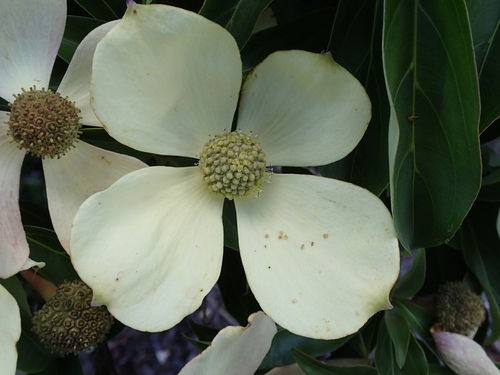
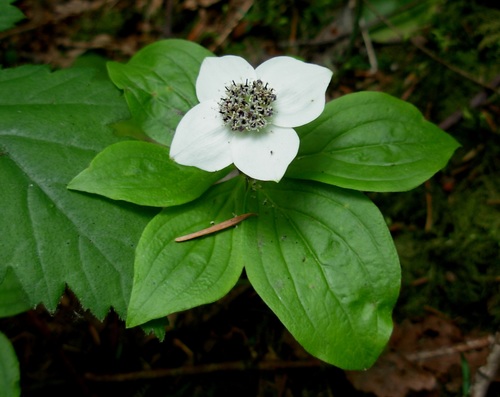
Cornus × unalaschkensis is a species of flowering plant in the dogwood family, Cornaceae. Its common names are Alaskan bunchberry, western cordilleran bunchberry, and simply western bunchberry. This species is native to the west coast of North America, ranging from Alaska to California, and also to Magadan, Russia. It is common, and even abundant, across the northwestern United States. This plant is a rhizomatous subshrub, with stems growing up to 20 centimetres (7.9 in) tall. Its leaves grow in a whorl, are oval-shaped, and reach up to 8 centimetres (3.1 in) long. Leaf texture ranges from hairless to hairy. Flowers grow in a cyme inflorescence, and are much smaller than the four white or pinkish bracts that surround them. The bracts measure 1 to 2 cm long, while the central petals are only about 1 millimetre long. The fruit is a bright red drupe that is 6 to 8 millimetres in length. It grows in habitats including forests and bogs, particularly areas with layers of decaying organic matter. The taxonomy of this plant is not fully settled. It is not always recognized as a distinct species; it is sometimes treated as a hybrid, noted by the hybrid symbol in the name Cornus × unalaschkensis, and is sometimes grouped as the same species as Cornus canadensis. Many authors, however, classify it as an allopolyploid, with chromosomes inherited from both C. canadensis and C. suecica. Careful examination of petal and leaf morphology can distinguish the three species, and C. unalaschkensis does not typically grow in the same regions as the other two. The fruit of this plant is edible, and various Native American groups including the Bella Coola and Kitasoo have used it for food. As one example, the Haisla mixed the berries with oolichan grease to make a mashed dessert.