About Cornus suecica L.
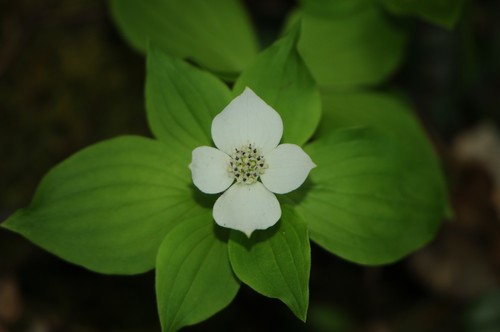
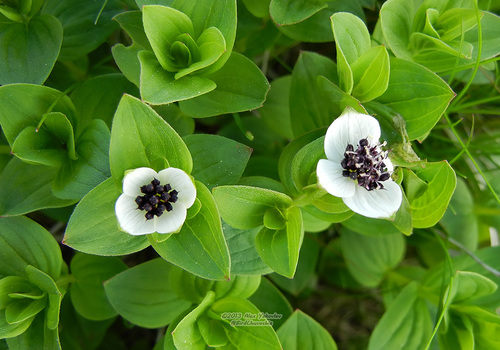
Cornus suecica L., commonly called dwarf cornel, is a rhizomatous herbaceous perennial plant that reaches a height of 20 cm (8 inches). It produces a small number of pairs of opposite, sessile cauline leaves, each measuring 2–4 cm (3⁄4–1+1⁄2 inches) long and 1–3 cm (1⁄2–1+1⁄4 inches) broad, with 3 to 5 veins originating from the leaf base. Its small dark purple flowers form a tight umbel, surrounded by four prominent white petal-like bracts that are 1–1.5 cm (3⁄8–5⁄8 inch) long. It produces red berries as fruit. This species grows in heaths, moorland, and mountains, and often grows beneath taller plants such as heather (Calluna vulgaris). Its range is nearly circumboreal, but it is not found in the continental interiors of Asia and North America. In North America, it occurs in Alaska (United States), British Columbia (Canada), eastern Canada including Labrador, New Brunswick, Newfoundland, Nova Scotia, and Quebec, as well as Greenland, and is absent from the region between these North American populations. Where Cornus suecica (a heath and bog species) and the forest species Cornus canadensis grow near one another in overlapping ranges in Alaska, Labrador, Finland, and Greenland, they can hybridize via cross-pollination, producing plants with intermediate characteristics.