About Cornus sericea L.
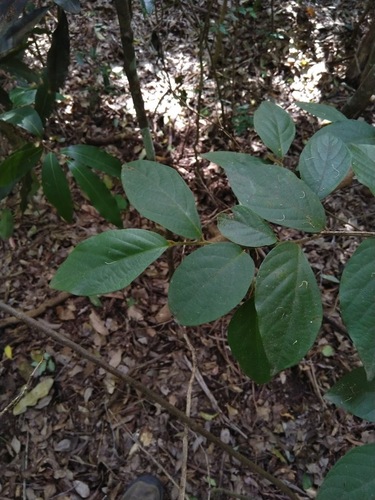
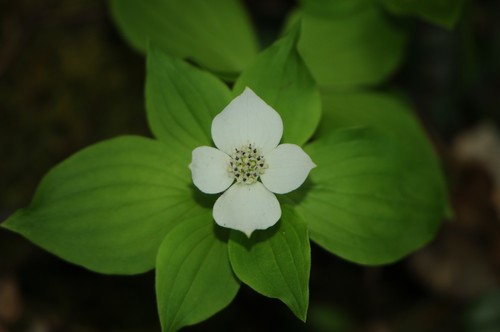
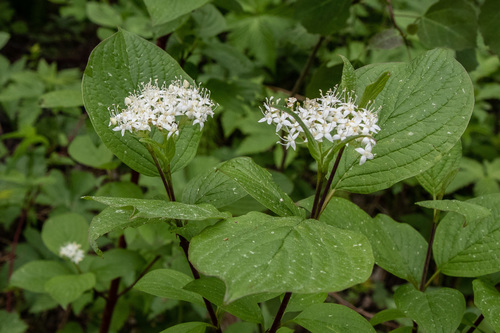
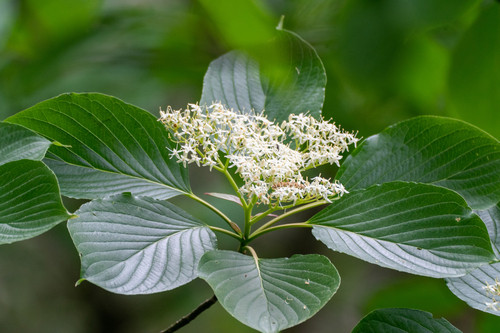
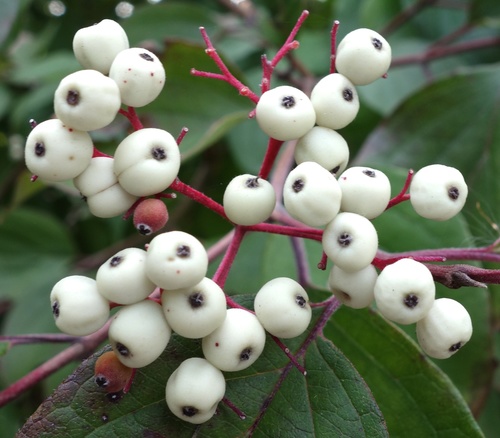
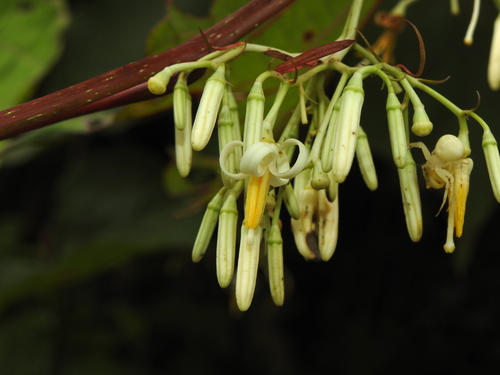
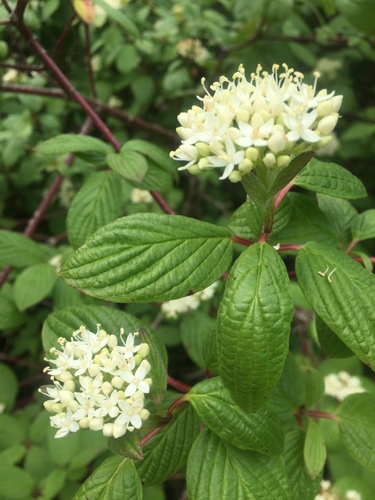
Cornus sericea L., commonly called red osier dogwood, is a medium to tall deciduous shrub. It grows 1.5–4 metres (4.9–13.1 feet) tall and 3–5 m (9.8–16.4 ft) wide, and spreads readily via underground stolons to form dense thickets. Its branches and twigs are dark red, though wild plants growing in shaded areas may not have this characteristic dark red color. Its leaves are arranged oppositely on stems, and measure 5–12 centimetres (2.0–4.7 inches) long by 2.5–6 cm (0.98–2.36 in) broad. Leaves have an ovate to oblong shape with an entire margin, are dark green on the upper surface and glaucous on the lower surface, and typically turn bright red to purple in autumn. Like all dogwoods, this species can be identified by the characteristic stringy white pith inside its leaf stalks. Its flowers are 5–10 millimetres (0.20–0.39 in) wide, flat, dull white, and arranged in umbel-like clusters that are 3–6 centimetres (1.2–2.4 in) across. Its fruit is a globose white berry 5–9 mm (0.20–0.35 in) in diameter, which is bitter and unpalatable. This species is native to boreal and temperate zones across northern and western North America, ranging from Alaska east to Newfoundland, south to Durango and Nuevo León in the west, and south to Illinois and Virginia in the east. It has also been recorded growing in counties Antrim and Londonderry in Northern Ireland. In the wild, it most commonly grows in areas with rich, poorly drained soils, such as riparian zones and wetlands, or in upland areas that receive more than 510 mm (20 in) of annual precipitation. It occurs less commonly and at lower abundance in drier zones. Red osier dogwood is tolerant of flooding, and has been known to survive up to seven years with water above its root crown level. It grows at elevations from sea level to 3,000 m (10,000 ft), and is most common above 460 m (1,500 ft) across many parts of its range. Red osier dogwood provides food and cover for many species of mammals and birds. Moose, elk, bighorn sheep, mountain goats, beavers, and rabbits browse its stems, especially new shoots. Its fruits are an important autumn food source for bears, small mammals, and 47 different bird species. In winter, ungulates browse this shrub heavily; in some areas browsing use exceeds availability, so unbrowsed individuals are rare. The shrub also provides important nesting habitat and cover for a wide variety of animals. Cornus sericea is shade tolerant but prefers intermediate to high light levels. It tolerates disturbance well, and appears early in both primary and secondary succession across its native range, particularly in floodplains and riparian zones. It thrives in fire-disturbed sites, sprouting from seeds or damaged shrubs. While its overall conservation status is secure, it is considered vulnerable in Iowa and critically imperiled in Kentucky and Virginia. Cornus sericea is a popular ornamental shrub, often planted for the bright red color of its twigs during the dormant season. The cultivars 'Bud's Yellow', 'Flaviramea' (with lime green stems), and 'Hedgerows Gold' (with variegated foliage) have gained the Royal Horticultural Society's Award of Garden Merit, confirmed in 2017. Like most dogwood species native to North America, C. sericea can be parasitized by the dogwood sawfly, which may leave most of the plant defoliated. A range of pesticides are effective against this pest, and hand-picking the larvae is also a successful control option. Cornus sericea is frequently used for waterway bank erosion protection and restoration in the United States and Canada. Its root system provides excellent soil retention, it is hardy and produces an attractive shrub even when bare in winter, and its ability to be reproduced from cuttings makes it a low-cost option for large-scale plantings. Some Plateau Indigenous tribes ate its berries to treat colds and slow bleeding. Known as čhaŋšáša in Lakota, the inner bark was used by the Lakota and other Native American groups as traditional tobacco, either on its own or mixed with other plant materials. Among Algonquian peoples such as the Ojibwe, smoking mixtures called kinnikinnick blended this inner bark with tobacco, while more western tribes added it to bearberry leaf to improve taste. The Ojibwe used red-osier dogwood bark to make dye, processing the inner bark and mixing it with other plants or minerals. Its withies, or osiers, are used in basketry.