About Cornus racemosa Lam.
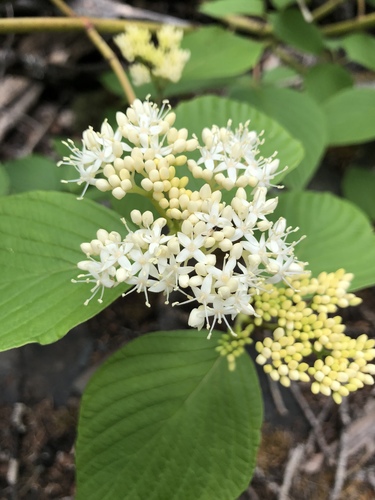
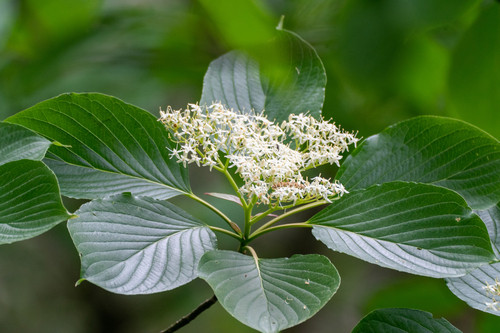
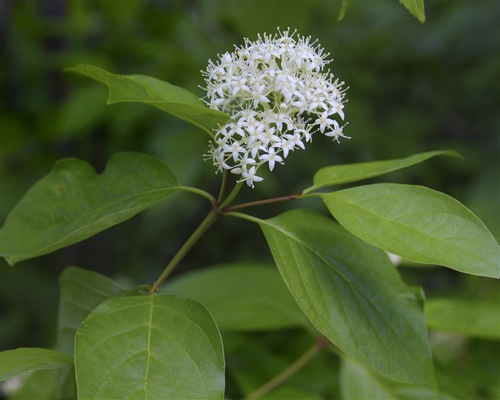
Cornus racemosa Lam., commonly called gray dogwood, typically grows 1.2 to 3 meters (4 to 10 feet) tall, and rarely reaches up to 8 meters (26 feet) in height. It frequently produces suckers from underground rhizomes, which leads it to form dense thickets. As its common name suggests, its bark is gray, and its twigs contain white pith. Its leaves measure 4 to 8 centimeters (1 1/2 to 3 1/4 inches) long and 1 to 4 centimeters (1/2 to 1 1/2 inches) wide, and usually have 3 or 4 pairs of lateral veins — fewer veins than most other dogwood species. This plant has an upright growth habit with a rounded overall shape. Its leaves are arranged oppositely along stems, and its flowers grow at the ends of branches. The small white flowers each have four petals 2.3 to 3 millimeters (0.091 to 0.118 inches) long, and are grouped into rounded 2.5 to 5 centimeter (1 to 2 inch) wide clusters called diachasial cymes. Flowering occurs between May and July. After flowering finishes, the plant produces green fleshy fruits called drupes, which ripen to white between August and October. Both the flowers and ripe fruits are held on bright red pedicels (stem stalks connecting individual flowers or fruits to the main plant). Many species of wild birds feed on the fruits of this plant. Old branches of gray dogwood grow slowly, while new stems grow quickly. In autumn, the foliage may turn reddish or purplish, though this color change is not very prominent when viewed from a distance.