About Cornus nuttallii Audubon ex Torr. & A.Gray
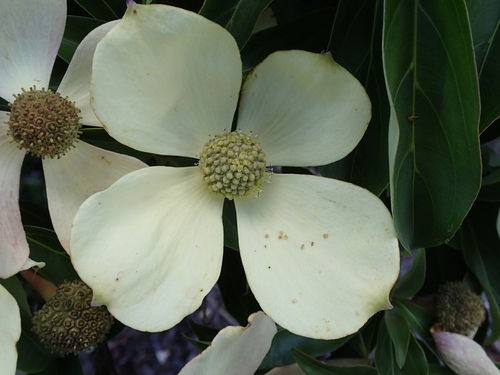
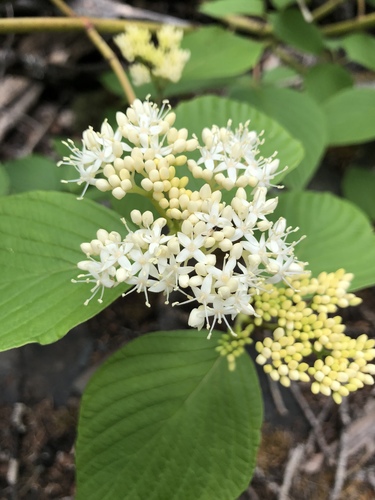
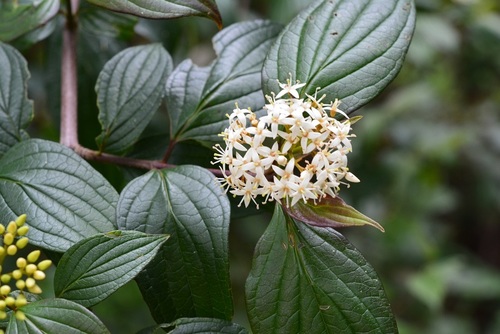
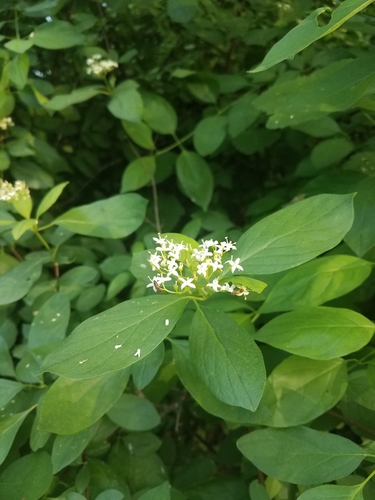
Cornus nuttallii Audubon ex Torr. & A.Gray is a small to medium-sized deciduous tree that grows 6 to 23 metres (20 to 75 feet) tall, with an average canopy spread of 6 m (20 ft). Its overall growth form changes based on how much sunlight it receives: when grown in full sun, it has a short trunk and a crown that is as wide as the tree is tall, while when it grows under an existing tree canopy, it has a tapered trunk and a short, slender crown. Tree trunks reach 15 to 30 centimetres (6 to 12 in) in diameter, and have reddish brown bark. The tree’s branches are covered in fine hairs. Young bark is thin and smooth, and develops a scaly texture with ridges as the tree ages. Leaves are arranged oppositely, are simple and oval-shaped, and measure 5 to 13 cm (2 to 5 in) long by 3.8 to 7.1 cm (1+1⁄2 to 3 in) broad. The upper leaf surface is green and covered in stiff, flattened hairs, while the lower surface is lighter in color and more hairy. Leaves turn shades of orange to purplish during autumn. Individual true flowers are small and inconspicuous, measuring 2 to 3 millimetres (1⁄16 to 1⁄8 in) across. These small flowers are grouped into a dense, rounded greenish-white flower head 2 cm (3⁄4 in) in diameter. The 4 to 8 large white petal-like structures visible around the head are actually bracts, each 4 to 7 cm (1+1⁄2 to 2+3⁄4 in) long and wide, which make the whole cluster look like a single large flower. This species commonly blooms twice per growing season: once in spring, and again in late summer or early autumn. The fruit, which appears in September or October, is a compound pink-red or orange drupe about 1 to 1.5 cm (1⁄2 to 1⁄2 in) long. Fruits grow in clusters that hold 20 to 40 individual drupelets, each of which contains two seeds. The fruits are unpalatable. In the wild, this tree occurs from the lowlands of southern British Columbia to the mountains of southern California, with a separate inland population in central Idaho where it is classified as critically imperiled. It grows predominantly at elevations below 1,500 m (4,900 ft). Cultivated specimens have been recorded as far north as Haida Gwaii. This species has high flood tolerance, and is common along streams with moist but well-drained soils, most often on gentle slopes. It can grow in soil textures ranging from clay to sandy loam, and prefers soils with high humus content, moderate to high nutrient levels, and acidic pH between 5.5 and 6. It has low frost tolerance, and is usually found in low-elevation temperate or mesothermal climates. It is hardy to USDA hardiness zone 7. Some Plateau Indian tribes, including the Nlaka'pamux, used the bark of this tree to make a brown dye. These groups also used the bark medicinally, as a blood purifier, lung strengthener, stomach treatment, laxative, and emetic. Today, Cornus nuttallii is mostly valued as a cultivated ornamental plant.